
Careers8 min read16 min video
Fewer jobs. More work. Both true.
Where the Game Dev Jobs Went, and How to Get Them

Key takeaways
- The games industry lost about 9,000 jobs last year and passed that number by August this year, yet there has never been more co-dev and freelance work.
- The game development outsourcing market is worth about $2.2 billion and is forecast to reach about $7 billion by 2035. Studios still want the work, not the staff.
- Studios now hire proof, not potential. Show finished work that looks like the job, at the level of the studio you want.
- Each career stage has its own job: entry level needs proof, juniors need reliability, mid-level devs need better rates and a buffer, seniors should package what they know.
- Use AI as a productivity tool for the business side and for finding opportunities. Keep the creative side yours.
Last year, games industry layoffs cost about 9,000 jobs. This year we hit that number by August.
And yet there has never been more co-dev and freelance work floating around in game development. Those two things are true at the same time, and nobody explains why. So this post is a survival kit: where the game dev jobs went, and how to go and get them, whether you’re chasing your first credit or you’ve been leading teams for years.
I’ve also put every tip here into a free PDF you can print and keep.

I’ve been on both sides of the fence
I’ve been in game dev for over 20 years, as an animator, an animation director and everything in between.
As a director, I’ve had to hire co-dev studios and freelancers to help ship a big AAA game. I’ve also been on the other side, as the freelancer and as the co-dev, which is what I do now at Rekindled. So I’ve seen a fair bit of the range.
The number one question I get, in my comments and on other channels too, is: where have all the jobs gone? There’s a feeling that you apply to a bunch of studios as a junior, or as someone trying to get in, and nobody gives you a chance. One animator with a strong portfolio and showreel has applied to 200 studios and still hasn’t found a job.
Where did the game dev jobs go?
Staff jobs, or full-time jobs as some people call them, have been dwindling. But the work hasn’t disappeared. Studios still want it. It has shifted, and once you see where, it changes how you think about applying.
The game development outsourcing market is now worth about $2.2 billion, and it’s forecast to reach about $7 billion by 2035.
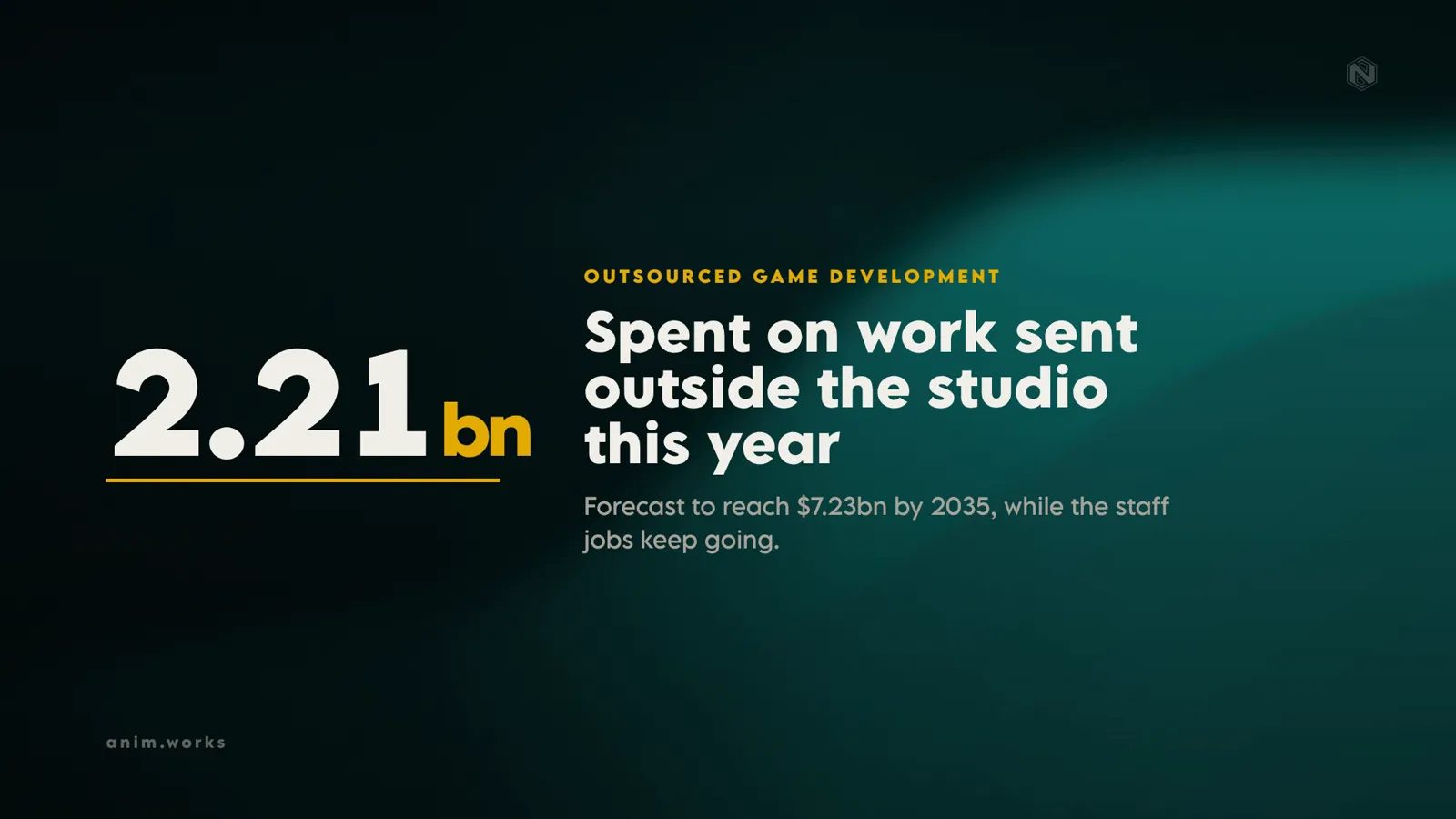
What that tells me, and what I see every day, is that studios still want the shots and the work is still there to be made. They just don’t want to hire the staff to do it. They’d rather hire a co-dev studio or a freelancer.
The work hasn't disappeared. Studios just don't want to hire the staff to do it.
Harvey Newman
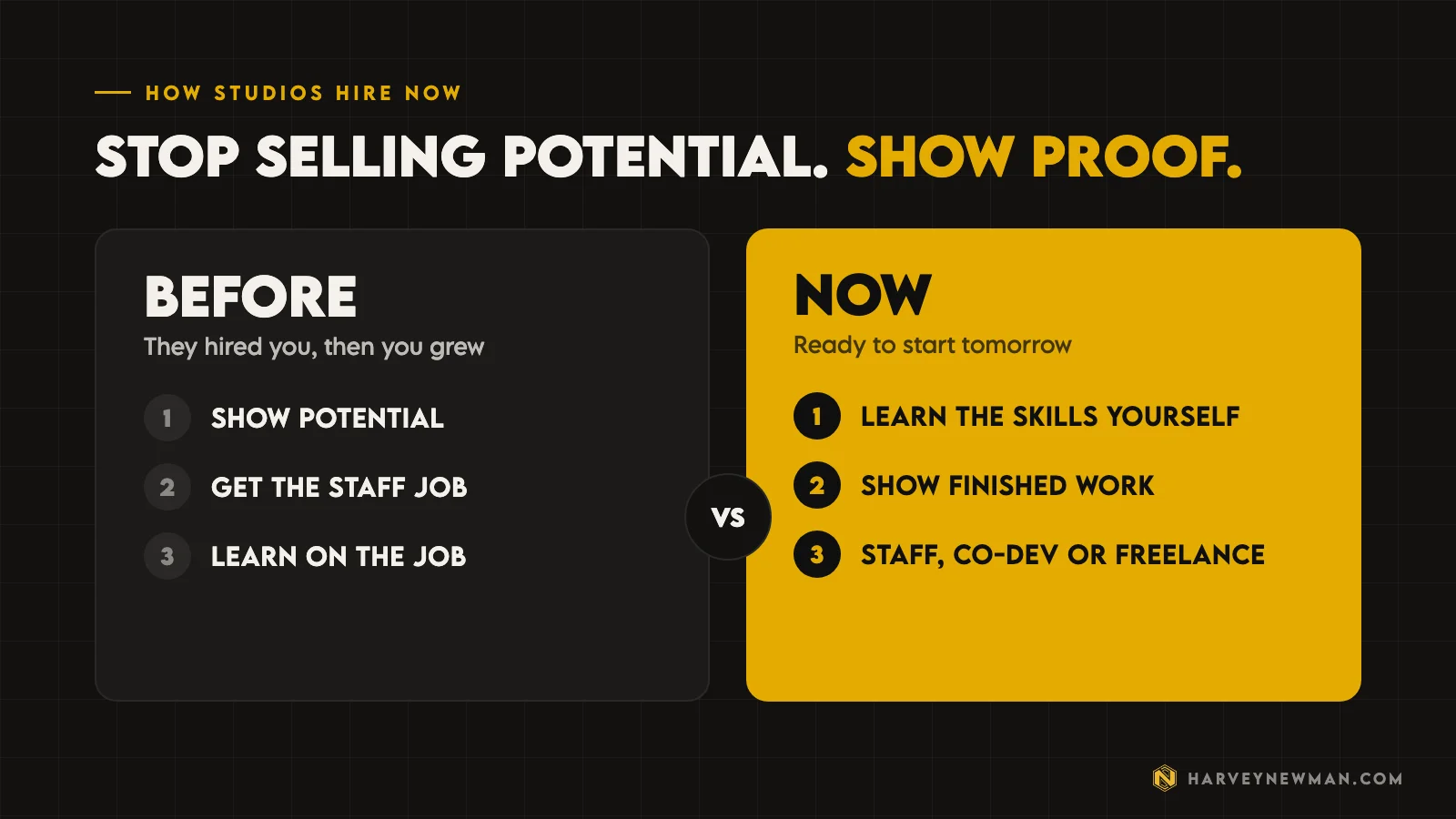
Proof over potential: how studios hire now
This is the first thing that needs to change in your head when you look for game development jobs.
It used to be about selling your potential. If your showreel or your design work showed potential, a studio would hire you, and you’d learn and grow on the job. That’s how it worked for a long time.
Now it’s about showing the finished product. You’re an animator, a studio or a person who is ready to do the job right now, at a high level. It doesn’t matter whether that’s as a staffer, a freelancer or inside a co-dev studio. You’re ready to start.
So instead of waiting for a studio to teach you, learn the skills yourself. Don’t lose time waiting for the right opportunity. Get your skills to a pro level, so you’re hirable however you start.
Why entry level game jobs took the worst of it
I won’t sugar-coat it. This isn’t a silver bullet for everybody, because entry level jobs have taken the worst of it.
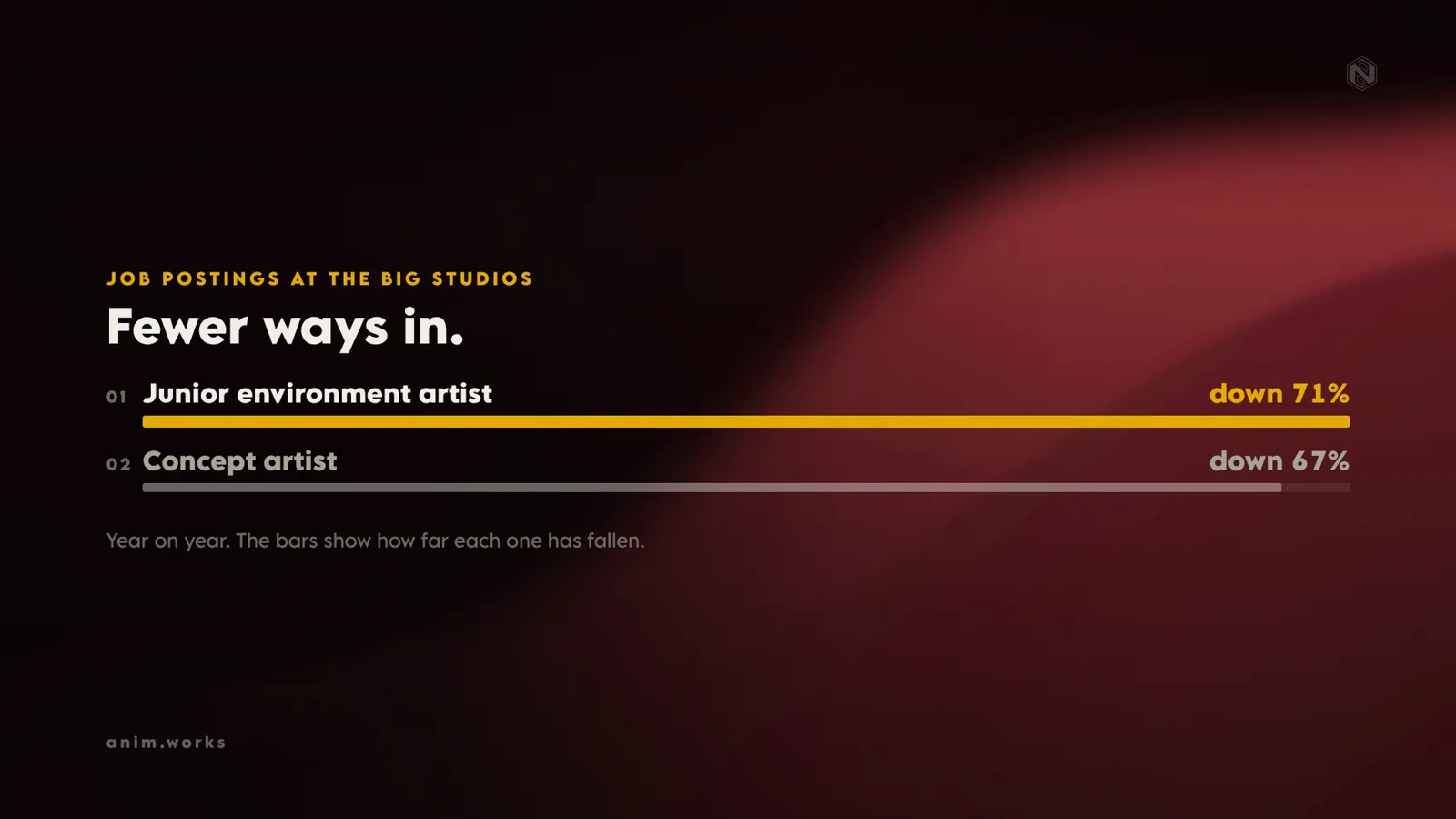
- Concept artist postings at the big studios are down about 67% year on year.
- Junior environment artist roles are down about 71%, as studios have senior artists do the work juniors used to do.
I still think there’s a way through, and it isn’t about trying to out-do AI. I’ll come back to AI at the end.
The game dev jobs survival kit, tier by tier
The tips depend on where you are in your career, so I’ve split them into four tiers.

Tier one: entry level
This is you if you have no paid credits yet: no job or project with your name on it that you were paid to do.
Your job, whether you’re a level designer, an animator or anything else, is to produce proof for studios, co-devs and clients that you’re ready to start working tomorrow. Until you have that proof, it’s hard for anyone to hire you.
- Make at least three pieces that look like the job you want. Think about the studio you want to work for, aim for that level, and keep making work that looks exactly like it. Nine times out of ten, that top-tier studio won’t hire you straight away. But plenty of other studios, co-devs and freelance clients will be glad to have you, because your work will be that good.
- Finish your work. The thing I see most from new animators, artists and game devs is unfinished work. I’d much rather hire someone with three to five fully finished pieces than someone with 20 unfinished ones. It’s not about quantity. Finished work tells me you’re dependable and will finish whatever we give you.
- No free work for companies that can pay. If it’s a friend’s passion project that isn’t making money, go for it: that’s experience you can show. If a company has investors and profits and won’t pay you, avoid it. It sets a bad precedent for the rest of your career.

Tier two: junior
You’ve got two or three years under your belt. My biggest tip here is to take on the freelance spirit of game dev.
The most successful game devs aren’t the ones with natural talent. They’re the ones who hit the deadline, every single time.
It will never feel fully finished. Even a super-polished AAA game has things that could have been done better. The faster you accept that, the better.
- Pick a lane. There’s nothing wrong with being a generalist who does a bit of everything, or a specialist who only does animation or design. Either way, pick one. It helps you become proficient.
- Learn to scope your work. If you keep telling a client or employer something will take three days and it takes more, or less, they stop trusting your quotes. Consistency works both ways.
- Use contracts. If it’s you and a mate on a passion project, fine. If you’re working for a company that makes money and has the funds, contracts are everything.
Tier three: mid level
You’ve been doing this for a while, perhaps getting close to eight years, and maybe you’re freelancing.
- Raise your rateFor new clients only, not current ones. Test the ceiling to find your number.
- Charge by the dayA day rate gives you a steadier payday than hourly billing.
- Get case studiesClients who will vouch for the work you did together.
- Build a bufferThree to six months of money in the bank.
Raise your prices if you can. With this much co-dev and freelance work around, your services are needed more than ever. But raise them for new clients coming in, not your current ones, because that scares clients away. How much? That’s up to you. Test the ceiling. I go in with a number slightly higher than expected and negotiate. Not so astronomical it scares the client, and not so low they think I’m cheap and the work will be cheap.
Move from an hourly rate to a day rate. It gives you a much more consistent payday. And when the client wants more tweaks and changes, you aren’t itemising every one by the hour, keeping track of hours and waiting for approval. That gets stressful fast.
Get case studies. Whether you work for yourself or for a co-dev, get clients who will talk about the work you did together and vouch for you.
Build a buffer of three to six months. This might be the biggest tip I can give you. Nothing is assured nowadays, even in a AAA studio. Financial security means your next step is taken calmly, with integrity, instead of at the last minute because you can’t pay the mortgage or the rent.
Tier four: eight years plus
This is where I am, and where I hope you’ll be.
- Package what you know. Take the knowledge you’ve gathered over all those years and turn it into something of value for clients, students or people in general. Put it in a course, or become a mentor. We run mentorships and courses at Animworks if you want to join us, and I’ve written about how to create an animation course. There are so many young people out there who want to absorb that knowledge.
- Get on the phone. With that much experience, you have connections. Use them. Have as many meetings as you can. When someone asks me for a chat, I might be a little apprehensive, but once I’m talking to them I’m always glad I did it. Studios feel the same way. As soon as they speak to you, their idea of working with you changes.
Will AI take game development jobs?
I’ve made videos about AI for the last two or three years. It was scary at the beginning, and things are starting to ease up. The more you use it, the more you see it’s about productivity and doing more with your time, not taking over our jobs. That’s how I feel, anyway.
You can hand more of the business side to AI and focus on the artistic side, because that’s what you’re there for. I don’t want to do the paperwork, the bills and the accounting. I’d much rather do the creative work.
It helps with ideation too. Sometimes I get stuck on what to make next, so I ask for opinions and suggestions. But it’s never AI doing the work. I take the idea and run with it myself, because originality is always the goal.
AI is a great productivity tool. Not so much a great creative tool.
Harvey Newman
If you’re a junior looking for work right now and don’t know where to look, you can use AI to search for opportunities that match your criteria.
Grab the free survival kit
The work is still out there. It has shifted into a new kind of dynamic, which I see every day through Rekindled and through my contacts. It’s up to you to go after it in a completely different way.
That’s why I made the Freelance Survival Kit for Game Devs, a free PDF with the steps above, room for notes and more. I won’t pretend it will solve everything, because it won’t. But it will remind you what to do next, wherever you are in your career. If you’re thinking about the move to freelance, I’ve also written about life as a freelance game developer, and about the reality of being an animator in 2026.
The jobs are still there. This is a wonderful industry, and I hope every one of you, experienced or not, gets the opportunity you’re looking for.
Where are you in your career right now? Come and tell me in the comments on the video.
The video
Watch the full breakdown
Questions people ask
Where did all the game dev jobs go?
Mostly into outsourcing. Staff jobs are dwindling, but studios still want the shots and the work. They now buy it from co-dev studios and freelancers instead of hiring staff. The game development outsourcing market is worth about $2.2 billion and growing.
How do I get an entry level game job?
Produce proof that you can start working tomorrow. Make at least three finished pieces that look like the job you want, at the level of the studio you want to work for. Finished work beats a big pile of unfinished pieces.
Why are entry level game jobs so hard to find?
Entry level has taken the worst of the cuts. Concept artist postings at the big studios are down about 67% year on year, and junior environment artist roles are down about 71%, as studios have senior artists cover that work.
Should I work for free to get into the games industry?
Not for companies that can pay. Helping a friend's unpaid passion project is fine experience. Working for free for a company with investors and profits sets a bad precedent for the rest of your career.
Should freelance game developers charge hourly or a day rate?
Harvey recommends a day rate once you're mid level. It gives you a more consistent payday and means you aren't itemising every extra tweak by the hour, which is stressful for you and the client.
And remember,
there are no shortcuts for animation.
 Stay well, stay safe,Harvey NewmanBook a free call →
 Looking for knowledge?How to Thrive in the Games Industry: The Long GameMy book on building a career in games and keeping it. CRC Press, 246 pages.Get the book →
 Looking for resources?Rigs, courses and mentors on AnimworksFree and paid rigs, courses from working pros, one to one mentoring and mocap packs.Visit anim.works →
 The Reality of Being an Animator in 2026: How an Animation Career Has Changed16 Oct 2026
 Freelance Animator or Game Developer? How to Adapt to the Co-Dev Future20 Mar 2026
 Leaving AAA and Going Independent: How I Did It After 20 Years2 Oct 2026
 How to Create an Online Course for Animation: What I Wish I Knew First24 Jul 2026