
Business8 min read15 min video
Co-dev is rising. Is your application ready for it?
Freelance Animator or Game Developer? How to Adapt to the Co-Dev Future
Key takeaways
- With layoffs and rising costs, studios are turning to co-development, the way film has long worked with crews that come in, do the job and move on.
- A smart application to a co-dev studio shows a company already set up, co-dev experience or a willingness to do it, and some entrepreneurial spirit.
- As a co-dev developer you represent the studio. Your professionalism, or lack of it, reflects on everyone.
- Clients reward good communication and over-delivering on knowledge, not crunch. That's how six weeks becomes six months, and six months becomes six years.
- Get ready now: set up a company, know your rate range, invoice professionally and budget for your own software licences.
The games industry is changing fast. With all the redundancies and layoffs, companies are looking for more efficient ways to make the same games without spending as much, and to be more flexible instead of so rigid, especially in AAA. That’s why I think the future of game dev is freelance, and why being a freelance animator or freelance game developer is becoming a real career path rather than a niche one.
Last year I talked about the rise of co-development. This post is for the people who want to work in it: game developers, animators, character artists, anyone who wants to apply to a co-dev studio like ours at Rekindled. There are specific traits that make you more or less successful as a freelancer in this world, and I’ll go through them.
Why is game development going freelance?
Film has worked this way for a long time. A film is made up of departments and crews that come in, do the job, leave, and go on to the next production. Games take much longer to make, but I think this is where we’re going next.
A few years ago, I’d never have imagined co-dev would be growing instead of shrinking. I’ve been on both sides of it. Earlier in my career I worked as a co-dev developer with studios in China, Sweden and LA, and I’ve worked alongside co-dev developers from Nigeria and other places. That gives me a decent idea of what to expect from both sides.
I used to see co-dev as something only big studios used, when they wanted a bump in the number or quality of assets. You’d keep a co-dev team for three months, six months, a year, and move on.
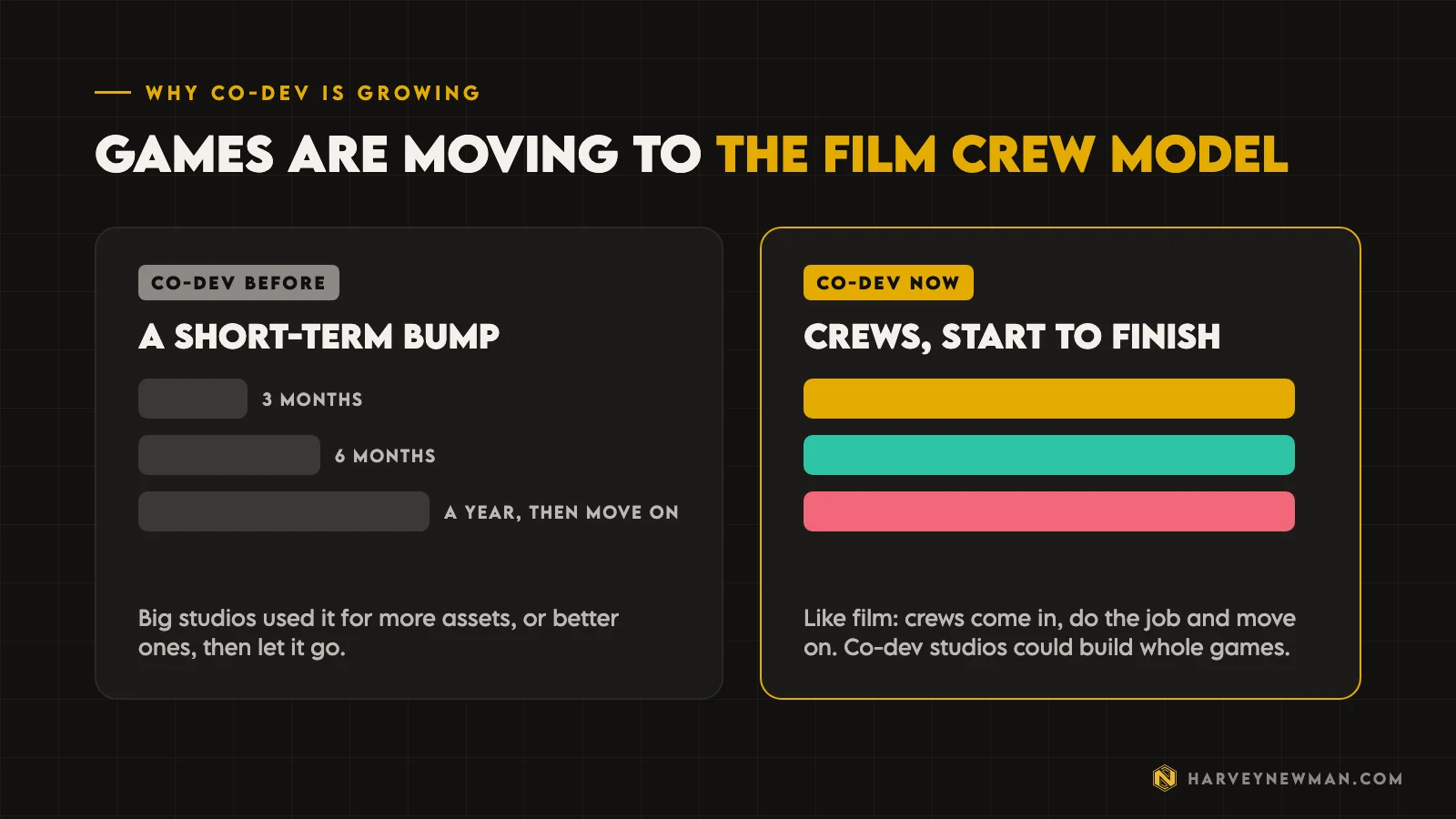
Now I think co-dev is becoming a big part of game development, and in future co-dev studios may help develop games from beginning to end. Knowledge is leaking out of this industry. Experienced developers are losing their jobs and want to make their mark, and studios are out there looking for exactly those developers.
There are more job opportunities if you know where to look. But you need to change your mindset a little.
What do co-dev studios look for in a freelance animator?
Let’s start with the difference between a regular application and a smart one.
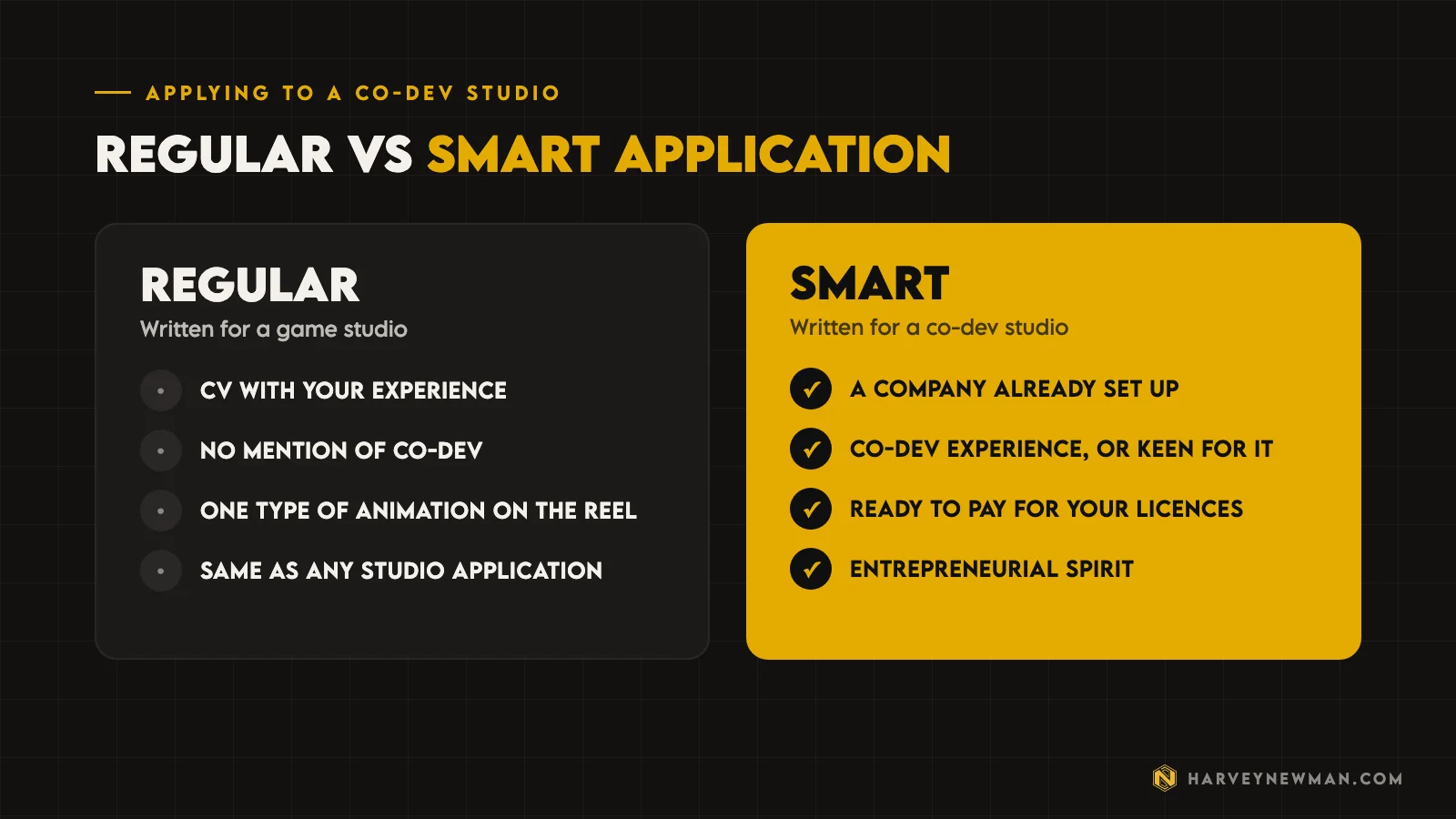
A regular application to a co-dev studio looks like an application to a game studio. A CV with your experience and a showreel, and that’s it. Nothing in the CV says you’ve worked with co-dev or that you’re willing to. The reel is built for a game studio, so it only shows one type of animation.
That’s fine. If you have talent, you have talent. If you’ve worked at great studios, even better. Co-dev studios look for many of the same things. But in some ways we look for different things.
A co-dev studio exists to help other studios. Some, like us at Rekindled, embed with the client’s team and become part of it. Others are more external and produce and deliver assets. Either way, the perfect candidate for us:
- Has a bit of entrepreneurial spirit.
- Has a company already set up.
- Has perhaps worked with other co-dev studios and knows what to expect.
- Understands that, for example, they pay for their own Maya licence, because they’re now working as an independent.
- Is willing to go the extra mile.
We want to bet on you and give you the opportunity, because we want everyone who is talented, humble and has a great personality. But we also need to know you’re set up to work.
The co-dev mindset: you represent the studio
This is where personality comes into play. Tenacity and professionalism matter more in co-dev than in a full-time job.
As a co-dev animator or developer, you represent the studio. If everybody is talented and knowledgeable, the studio looks good to clients around the world. The opposite is true too. If people are lazy or unprofessional, that starts to show the world what the studio is.
With co-dev, you have to be on your toes all the time.
Harvey Newman
In a salaried job, especially once you’ve passed probation, it can feel cushy. You can relax. In co-dev you carry more responsibility than when you’re working for the paycheck.
The personalities that thrive as a freelance game developer
At Rekindled, these are the traits I see in the people who do well:
- Humble but skilledLots of experience, still hungry, and still saying: I'm not that great, I still have things to learn.
- Treat others wellThat human connection matters. Treat others how you'd like to be treated. We're all there to lift the studio.
- LongevityGames take a long time. Commit to a six month or two year project and see it through, with a good attitude.
- Client skillsEspecially for leads, producers and directors, who deal with clients every day.
On treating people well: I talked about this in my last video. I don’t think it’s something you can fully learn. Maybe a little, but it’s mostly innate.
On longevity: once you commit to something, that commitment matters to any co-dev studio. If you say you’ll do something for the next year, be ready to do it with a nice attitude. If you’re not happy, talk to us. At a co-dev studio like ours there may be other projects you can move to. That professionalism counts.
How to get and keep clients as a freelancer
If you’re a lead, a producer or a director in a co-dev studio, you’ll be dealing with clients day to day, in meetings and calls. That’s another angle you have to handle.
You’re now one layer removed from game development. In a studio, you talk directly to the game director. In co-dev, depending on the project, you might still do that, but more likely you’re talking to a lead in the client studio who looks after the co-dev teams.
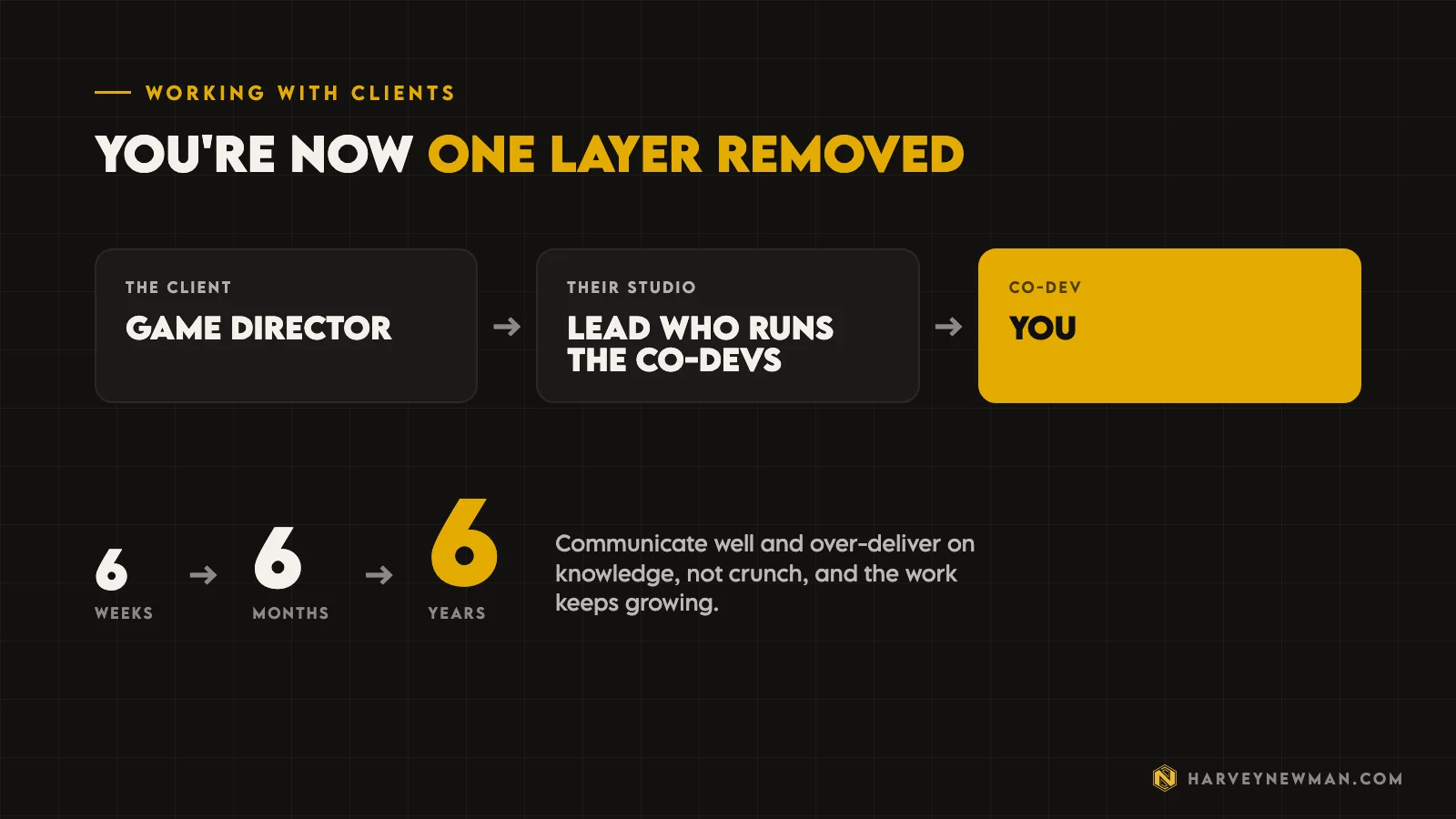
Communication becomes super important, because you’re not just doing a job. You’re looking after a client. If the project is going well, you want to extend it: six weeks into six months, six months into six years. That’s how co-dev grows.
Over-deliver if you need to. Not in terms of crunch, but in the work and the knowledge you bring.
You want to keep the ball rolling with different clients at all times. It’s a skill you don’t build in a full-time studio job.
How to set up as a freelance animator
What can you do right now to get ready for the co-dev world I think is coming?
Companies are set up differently around the world. But one thing is true everywhere: when you start in co-dev, you’re usually starting as a freelancer, or as your own company that lends its services to a co-dev studio.
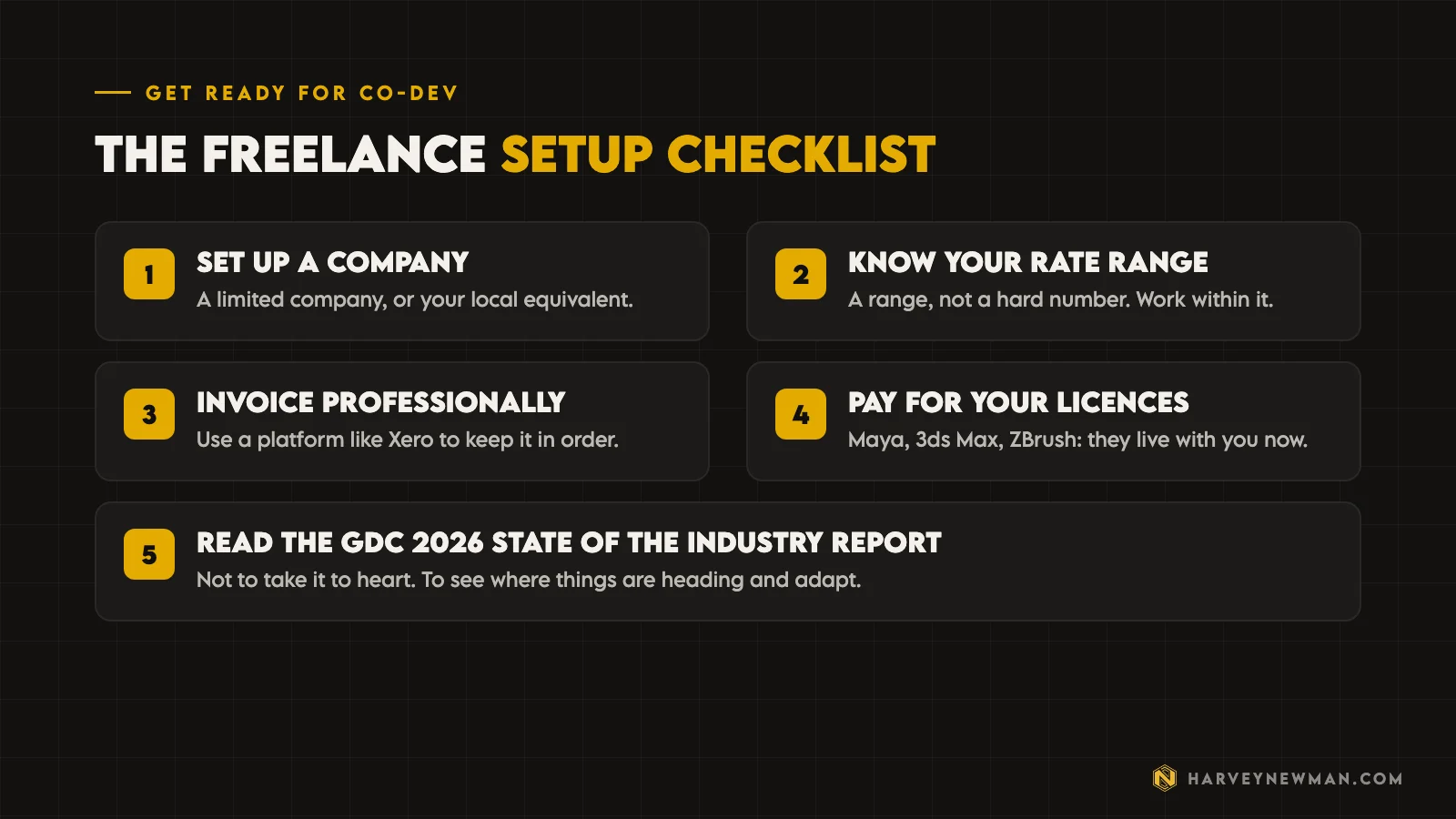
1. Learn how to set up your own company. In the UK that’s a limited company. Having one gives a co-dev studio peace of mind that you’re set up to work with them, and they can hire your services. It isn’t the only way to work with co-dev studios, and it depends on the individual, but knowing how to do it pays off in the long run.
2. Know your rate range. By this point you shouldn’t be asking how much you should get paid. You should know roughly what you’ll charge depending on the project, the studio and how much you want to work on it. Don’t have one hard number. Have a range, and work within it.
3. Invoice professionally. Use a platform like Xero, for example. It’s part of your business, so invest in it. You’ll have one place to keep all your invoices in order.
4. Be ready to pay for your own licences. If you use Maya, 3ds Max or ZBrush, those now live with you, and you pay for them. This stops many people. When you find out you have to pay to do the work, it’s a bit of a shock.
You have a business, so you need to invest in the business.
Harvey Newman
What you pay for a licence is small compared with what you earn. In my experience, even after taxes and software, contracting for a co-dev studio often pays more than a staff job at a big studio.
Is freelance the future of game development?
I’ve just read the GDC 2026 State of the Industry report. The main takeaway for me is that the industry is in a reset phase. Everybody is trying to work out where we’re going and how we’re going to do things.
The best thing you can do as a professional is adapt. Read the report, but don’t take it to heart, because much of it describes what has already happened. Just know you need to change your ways a little to fit where we’re heading.
Nobody knows for sure where that is. I can’t say for sure that co-dev is going to explode. But everything I’ve seen so far points that way, and some reports I’ve read recently suggest around one in five animators already work freelance. If that’s right, freelance animation is becoming the new reality instead of the niche it used to be.
I don’t think the next 10 years are going to look like the last 10 years.
So there’s no harm in getting used to the idea. Set up a company if it doesn’t cost you much. Get Xero, or something like it, if you can afford it. Look for clients, and inquire with co-dev studios to see if they’re interested. You can apply to us through the Rekindled website too.
If you’re further along and thinking about leaving a staff job for good, I wrote about leaving AAA and going independent after 20 years. If you’re earlier in your career, my courses and mentorship at Animworks will help you build the skills studios hire for. And if you run a studio and want help building or scaling a co-dev animation team, that’s what my consultancy is for. You can book a free call to talk it through.
What do you think about this new future we might be facing? Come and tell me in the comments on the video.
The video
Watch the full breakdown
Questions people ask
How do I become a freelance animator in games?
Most co-dev work starts with you as a freelancer or your own company lending services to a studio. Set up a company if you can, know your rate range, get used to invoicing, and budget for your own software licences. Then apply to co-dev studios with that set-up in place.
What do co-dev studios look for in a freelance game developer?
Talent and a strong reel, like any studio, plus a company already set up, experience with co-dev or a willingness to do it, entrepreneurial spirit, humility, good people skills and the commitment to see a long project through.
How much should I charge as a freelance animator?
Harvey's advice is to work from a range rather than a hard number. The range depends on the project, the studio and how much you want to work on it. By the time you go freelance, you should already know roughly where you sit.
Do freelance animators pay for their own software?
Usually, yes. If you use Maya, 3ds Max or ZBrush, the licences become your business cost. Harvey's view is that this is small compared with what you earn, and that after taxes and software, contractors often still earn more than staff.
How do you get clients as a freelancer in game development?
Apply to co-dev studios with a smart application, and inquire with studios that might need you. Once you're working, communicate well and over-deliver on knowledge, because good clients extend projects and keep the work coming.
And remember,
there are no shortcuts for animation.
 Stay well, stay safe,Harvey NewmanBook a free call →
 Looking for knowledge?How to Thrive in the Games Industry: The Long GameMy book on building a career in games and keeping it. CRC Press, 246 pages.Get the book →
 Looking for resources?Rigs, courses and mentors on AnimworksFree and paid rigs, courses from working pros, one to one mentoring and mocap packs.Visit anim.works →
 Leaving AAA and Going Independent: How I Did It After 20 Years2 Oct 2026
 Where the Game Dev Jobs Went, and How to Get Them18 Sept 2026
 The Reality of Being an Animator in 2026: How an Animation Career Has Changed16 Oct 2026
 What Is Animation Consultancy? What an Animation Consultant Does for Your Studio9 Oct 2024