
Careers9 min read19 min video
Good at keyframing isn't enough anymore.
Game Developer Skills the Industry Wants Now: How to Future-Proof Your Career
Key takeaways
- Fewer roles and higher expectations mean studios want people who solve problems, not people who only take tasks.
- Being good at keyframing, following tutorials and knowing one piece of software is no longer enough on its own. Skills matter more than tools.
- Gameplay animation is becoming more important as studios outsource more cinematics. Understand design, implementation, timing and metrics.
- You don't need to become a technical animator, but you should know motion matching, root motion, blends and how to debug your animation in a build.
- Communication is the underrated game developer skill. People who explain decisions clearly and keep a team together are the last ones a studio lets go.
If you’re a game developer, an animator or an artist, you’re probably asking yourself one question: am I learning the right things, or am I going to be left behind? This post covers the game developer skills I think studios want right now, and what I’d focus on if I were starting over.
I’ve been in the industry for many years, in AAA and indie. I have my own game studio, and we run an animation co-dev studio that hires people. I’ve seen plenty of people succeed in this environment, and I’ve seen plenty fail.
Why future-proofing your game dev career matters now
Things are changing. Between AI and the state of the games, film and VFX industries, nearly every video I’ve made lately has been about change.
There are also fewer roles and higher expectations. What that tells me is that studios want more quality and less quantity. That’s what normally happens when things contract. Only the people at the top, who have future-proofed their skills and keep learning and doing their best work, survive at that top layer.
That means people who like to solve issues, not people who wait to be given tasks and then do them. This is a real differentiator.
I don’t think this speed is going to slow down. If anything, it’ll speed up. So it takes someone who doesn’t need to be comfortable, someone who’s fine knowing they don’t know everything. That hurts. It’s painful and uncomfortable for most people, which is why sitting in a cushy job and collecting a paycheck feels so much better, and why it feels unfair when that’s taken away.
But I genuinely think the people who will thrive are the ones who see a problem and ask, “How can we solve it?”
Future-proofing doesn’t mean predicting the future perfectly. It means making sure your skills stay relevant while the software changes.
Which skills are dying out?
I don’t think it’s going to be the animation skills, or the things you love. It’s certain expectations that are going to die out.
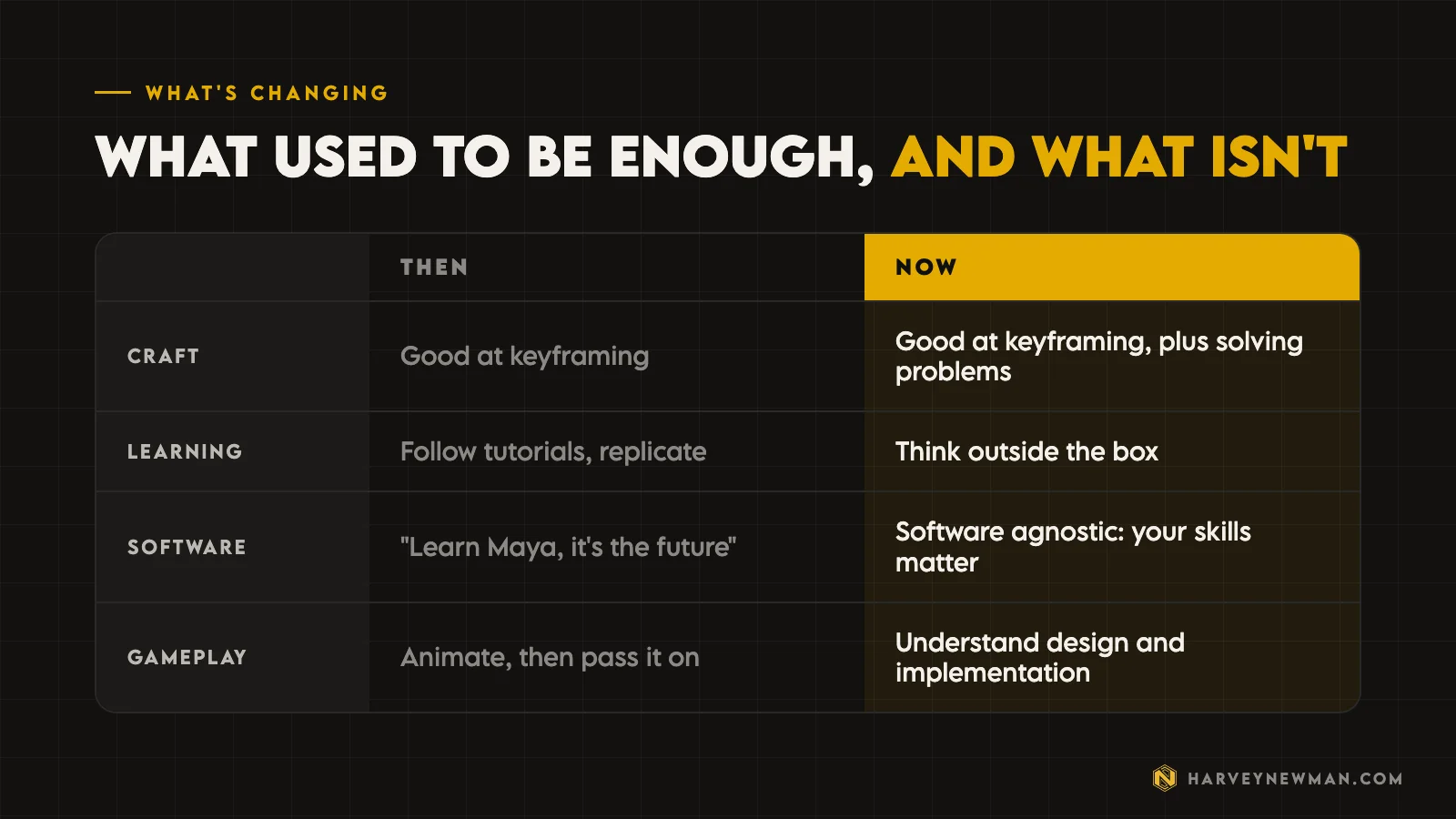
Being good at keyframing isn’t enough anymore. It’s good in the beginning, definitely if you’re a new animator. Perfect your craft and be the best animator possible, because that’s the foundation for everything else here. It just used to be enough on its own, and I don’t think it will be anymore.
Following tutorials isn’t enough either. Being able to replicate something well won’t cut it. People are going to want you to think outside the box and make something unique.
Software vs real skills: does your tool still matter?
Software has always been a linchpin for us, especially from the early 2000s, when it was all new and fresh. I remember clearly: Maya was the future. Learn Maya and you could work in films, in games, in VFX. That was it.
Most of you reading this have probably tried Blender, are probably using it, and might think it’s better than Maya. Blender is free, open source and community-driven, with a huge community behind it, so it’s only going to get better. Unreal is free to start with too.
I think we’re moving towards a software agnostic future, where your skills are what matters most, not the software you use.
“How much Maya do you know?” was a big question when I started. Not so much now. If you’re weighing the two, I compared them in Blender vs Maya.
What do game studios want now?
Based on my experience in studios and what I’ve seen, here’s what game, film and VFX studios are looking for. This next part is mostly about games.
1. Why gameplay animation skills matter more than ever
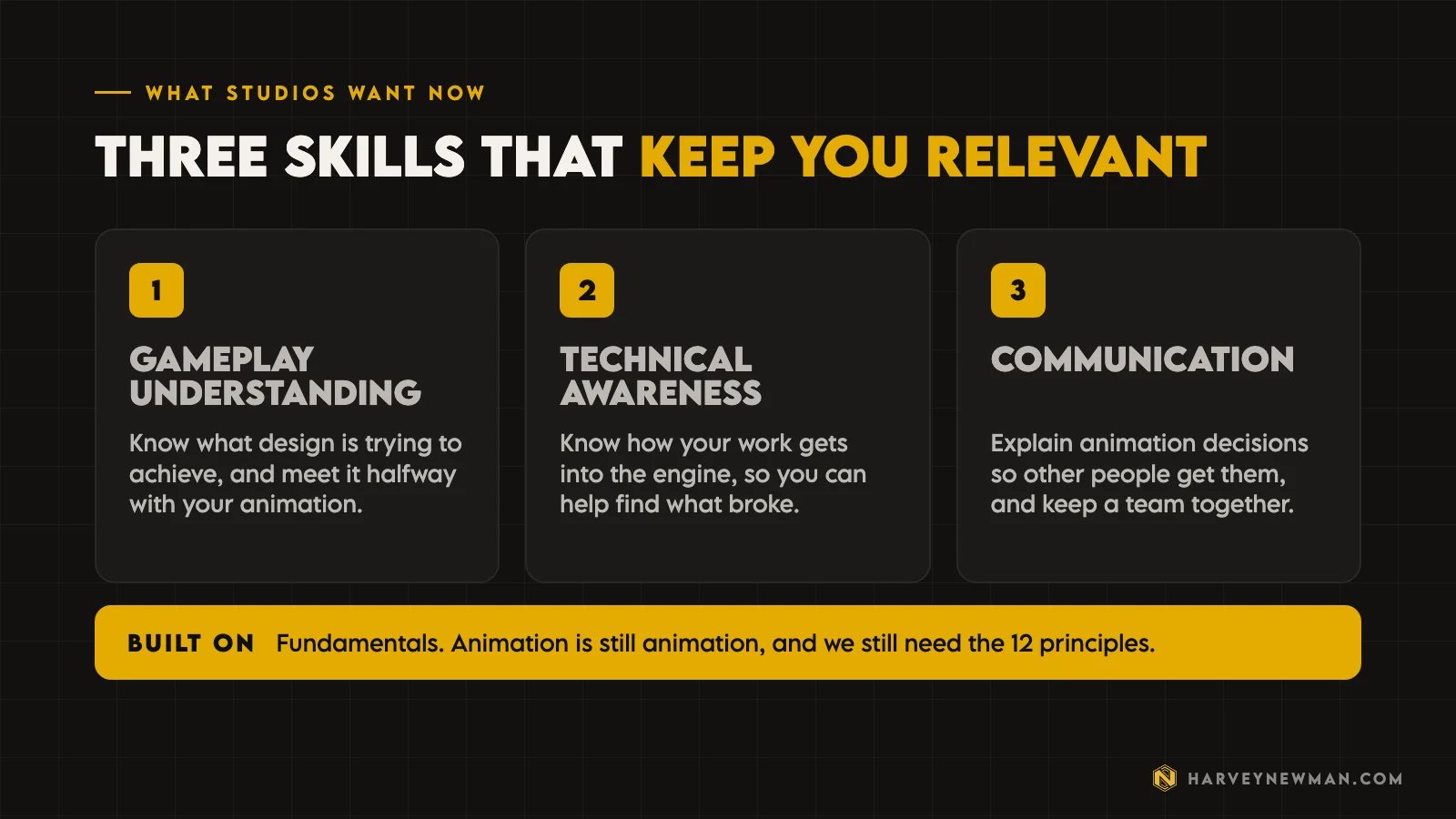
Number one for games is animators who understand gameplay.
From my perspective, cutscenes are going to become more of an outsourced job. Games used to have cutscene-specific animators and gameplay animators, in departments that worked together or separately. I think the cinematic side will be outsourced, the way film works with the Wetas and Lucasfilm of the world.
It’s been like that in games for a while, just under the radar. When I worked on Horizon Zero Dawn, I wasn’t at Guerrilla. I was at Axis in Scotland, a studio that specialised in cinematics, and which is no longer around. Many studios around the world work the same way. Now that studios are trying to save money, I think it’ll happen more and more.
Which tells me that, if I’m right, gameplay animation is going to be even more important than before.
To be the best gameplay animator out there, you need to understand design. When I started, you animated, passed the animations to a tech animator or a designer, and they put them in the game. Now animators are starting to implement their own animations and understand the technical side of the game.
I was against that at first. But I worked at DICE, where for the most part we were technical animators more than animators, and that understanding of the technical side helped me appreciate games so much more.
To be the best animator possible, you need to know what design is trying to achieve and how your animation can meet it in the middle. Understand it all the way down: how it’s implemented, the timing, the metrics. That makes you a better animator as a result.
How do you fix animation issues in game?
The last thing a gameplay animator needs is the ability to fix issues.
Many animators are still stuck on: “I did my animation, I checked it, everything’s correct. Can you tell me what’s wrong?”
Animation and code often butt heads, and I understand both sides. Code wants something practical and functional. Animation wants something beautiful that the game doesn’t interfere with. Then you put it in the game, it’s broken, and you ask why your beautiful thing doesn’t work.
If you know more about design and implementation, then when someone asks you a question, you’ll have a rough idea where the problem is. Maybe it was the transition. Maybe the blend. Maybe the logic behind it, or a Blueprint node that isn’t set up well. You can say, “I’ve done it this way before, I think this might work.” Then your animations translate to the game much better.
Japan is a good example. From what I’ve seen, many animators there have had this technical know-how of implementation for years, way ahead of us. I think that’s where we’re heading too.
2. Technical awareness: do you need to become a technical animator?
I want to be clear: you don’t have to become a technical animator to know these things. They’re two different roles. An animator animates. A tech animator implements or rigs. Doing some technical work doesn’t mean you lose your love for animation.
If you want your animations to translate to the game as well as possible, learn what goes on in the engine. Then you can reverse-engineer it and build your animation so it works. If you’re making an idle, a loop and another idle, you need to know exactly what the system needs, because every game’s system is different.
The tech animation team will probably still implement it. So pick their brains. Ask them how they do it, what makes it tick, which Blueprints they use.
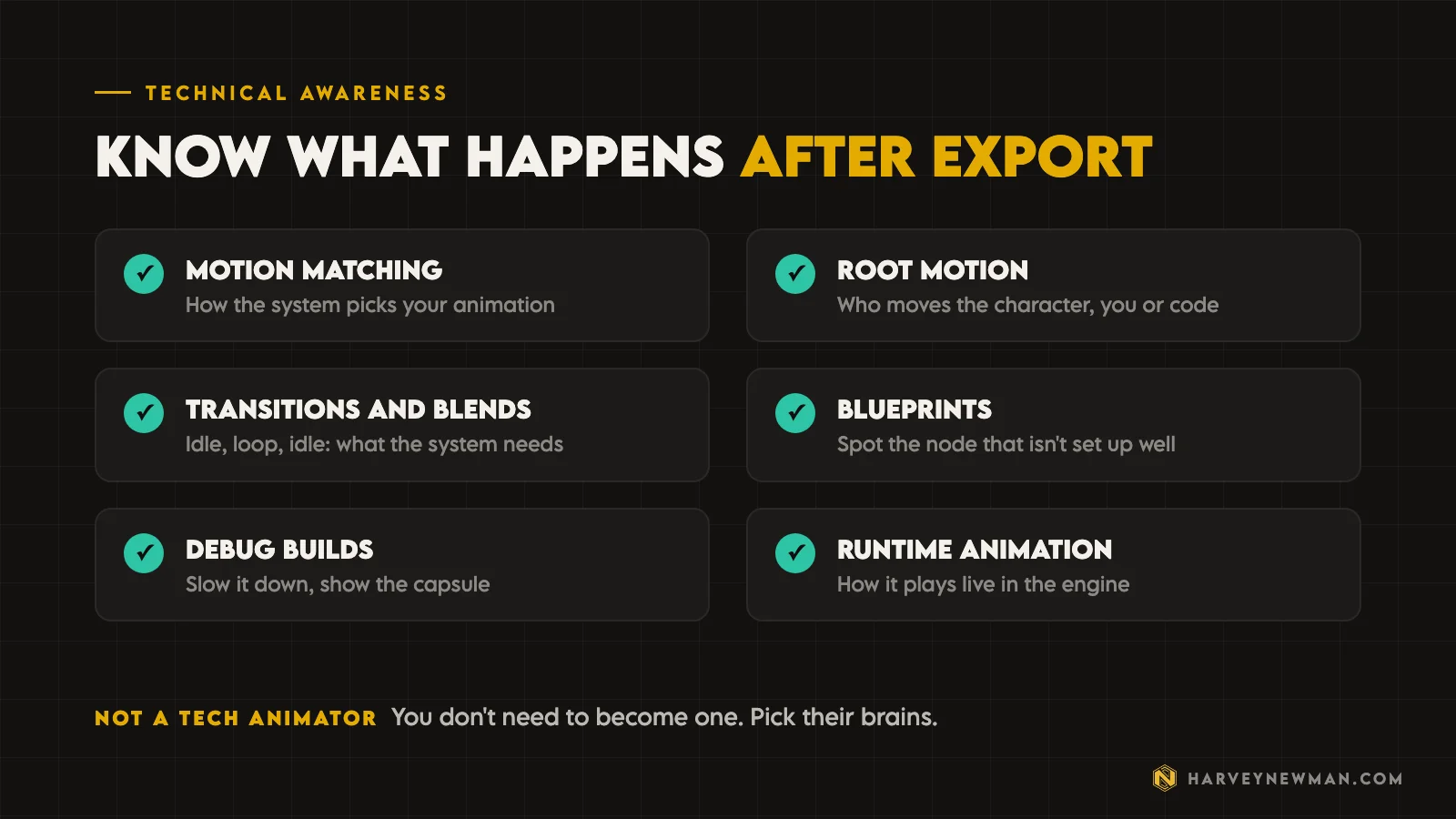
- Motion matchingGet familiar with how it works and how it picks your animation.
- Runtime animation and root motionRoot motion is a big one. Know how your animation plays live in the engine.
- Basic debuggingLoad the builds, slow your animations down and show the character's capsule.
- Find the transitionUse a debug command to see exactly where a transition goes wrong, then say: "My animation is this, but in game it looks like this."
Work in a way that lets you pick the brain of someone more technical than you, so you learn as you go. I cover how all these pieces fit together in the game animation pipeline.
3. Communication: the underrated game developer skill
Number three is highly underrated and important: the human side of this industry.
Good communication skills matter, especially now that many of us work from home some of the time and it’s harder to connect with people. Most of all, it’s being able to explain animation decisions and feedback in a way people understand.
What YouTube has taught me most is that the things in your head, however clear they are to you, might make no sense to anyone else. Explaining what you think can even confuse people more.
This matters even more if you become a lead or director one day. Games take a long time to make, and keeping a team happy for years takes a lot. I’ve been doing it for a while, and it’s deeply satisfying when you realise that what you say, and how you say it, means a lot. It can be as small as how you review somebody’s work.
Studios see that skill as gold. You need the skills and the knowledge, but then you need to not be a douche about it. It’s not about me, the lead or director, look at everything I’ve done. It’s about the team. Can I keep the team together and feeling good?
Studios will go, "We'd better let these people go before we let go of this one."
Harvey Newman
Animators who do all of this, the talent, the communication, the output, become a bit of a gem. They’re so valuable that teams can’t afford to lose them. That’s where you want to be at all times.
What would I focus on if I started again today?
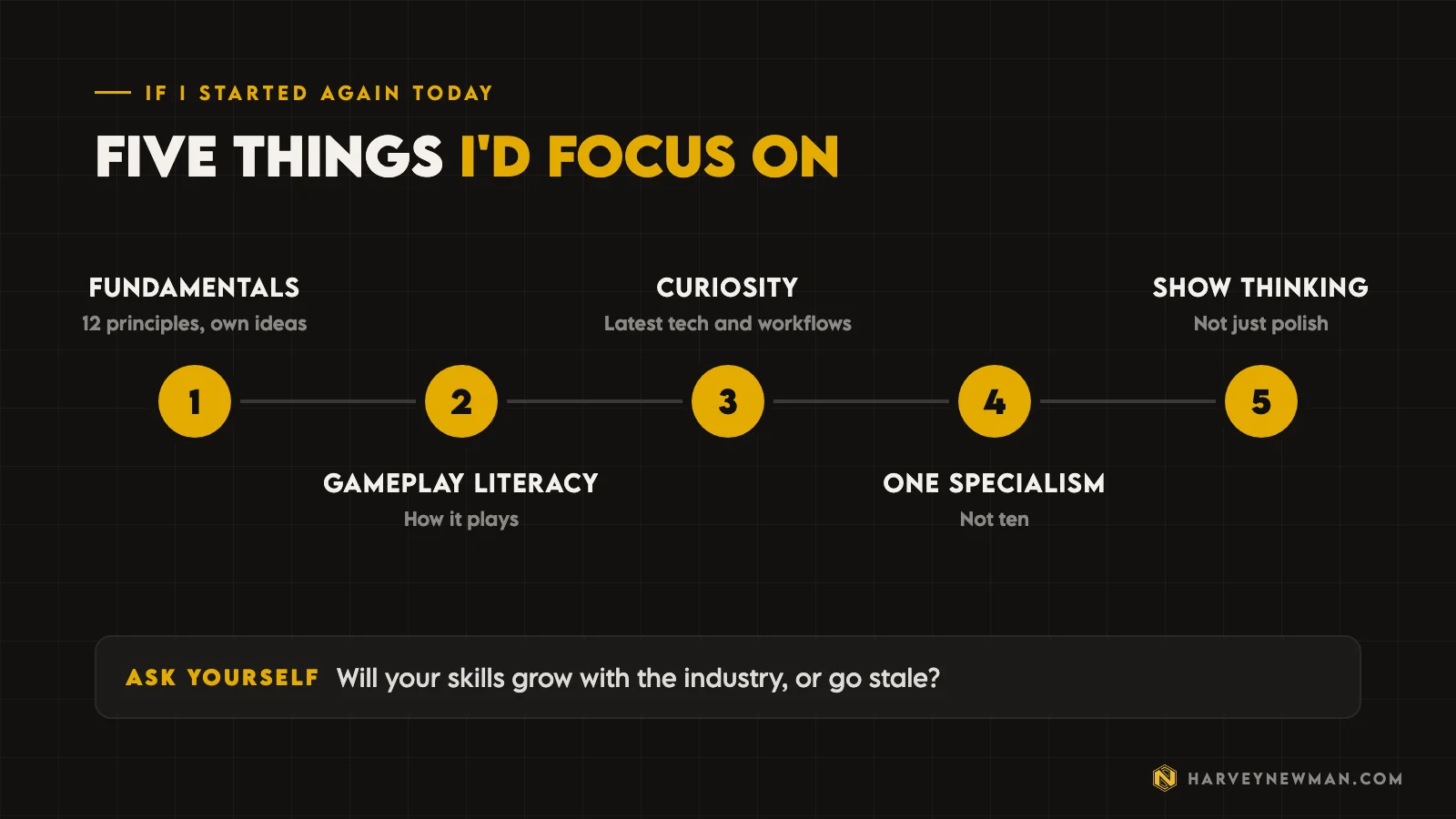
Start with the fundamentals. Animation is still animation, and that isn’t going to change. We still need the 12 principles. We still need the craft skills. And we still need ideas from outside the box, ideas only you can have. The smaller the industry gets, the more we need those people, because they’re the ones who stand out.
Learn gameplay. How does it work? Be curious. Always look at the latest tech, the latest Unreal and Unity updates, the latest workflows and pipelines.
Choose one specialism. Put all your energy into one thing instead of ten. Especially with this AI situation, I believe the more specialised you are, the more valuable you’ll be. AI tells everybody they can make great things with one click. History says the opposite: to make something worthwhile, you spend time crafting and learning it the hard way. I don’t know exactly how it’ll happen, but I think we’ll come back to realising that one click doesn’t solve everything. We need humans, ideas, creativity and the hard grind. Animation takes a lifetime.
That isn’t the same as staying narrow. Pick one craft and get good at it, then build gameplay and technical knowledge around it. I go into the specialist and generalist lanes in five games industry myths.
Show your thinking. On your showreel, personal projects and game jams, show more than polish and the wow factor. Show that you understand gameplay, workflows and how things are put together.
If you did that for yourself out of passion, imagine what you could do for a studio when they pay you to.
Then in an interview, people ask about your thinking instead of only being amazed by what they see. “It took us three years to get to this stack, and you did it in a month or two. How?” You can walk them through it, and they’ll be even more impressed by the process, because it took hard work, plenty of thinking and plenty of trial and error. If you want help with that side, I have a showreel course on Animworks.
Adapt or fall behind
The games industry will keep changing, and the pace is speeding up, not slowing down. What’s in your control is whether your skills grow with the industry or go stale and leave you behind. That’s the question to ask yourself.
Being stubborn right now is the worst thing you can do for yourself.
Harvey Newman
People in tech and games will keep moving forward. Adapt quickly, get out of your head and focus on what you know you can produce. If it’s tough out there for you right now, I also wrote about what to do when animation jobs dry up.
Where are you in your career: student, junior, mid, senior or lead? I’m genuinely curious. Come and tell me in the comments on the video.
The video
Watch the full breakdown
Questions people ask
What skills do you need to be a game developer in 2026?
Strong fundamentals in your craft first. On top of that, studios want gameplay understanding, technical awareness of how your work gets into the engine, and good communication. Being able to solve problems, not only complete tasks, is what separates people now.
What skills does a gameplay animator need?
A gameplay animator needs to understand what design is trying to achieve, how animations are implemented, the timing and the metrics. Knowing transitions, blends, root motion, motion matching and Blueprints helps you work out why something looks broken in game.
Do game animators need to learn technical animation?
You don't need to become a technical animator, which is a separate role. But learning what happens in the engine, and picking the tech animators' brains, makes your animation translate to the game much better.
Is Maya still the industry standard for game animation?
Maya used to be seen as the future for games, film and VFX. Many people now use Blender, which is free and open source, and Unreal is free to start with. I think we're moving towards a software agnostic future where your skills matter more than the tool.
What should be on a game animation showreel now?
Projects that show thinking, not only polish. Show that you understand gameplay, workflows and how things get put together, so the interview becomes a conversation about how you did it.
And remember,
there are no shortcuts for animation.
 Stay well, stay safe,Harvey NewmanBook a free call →
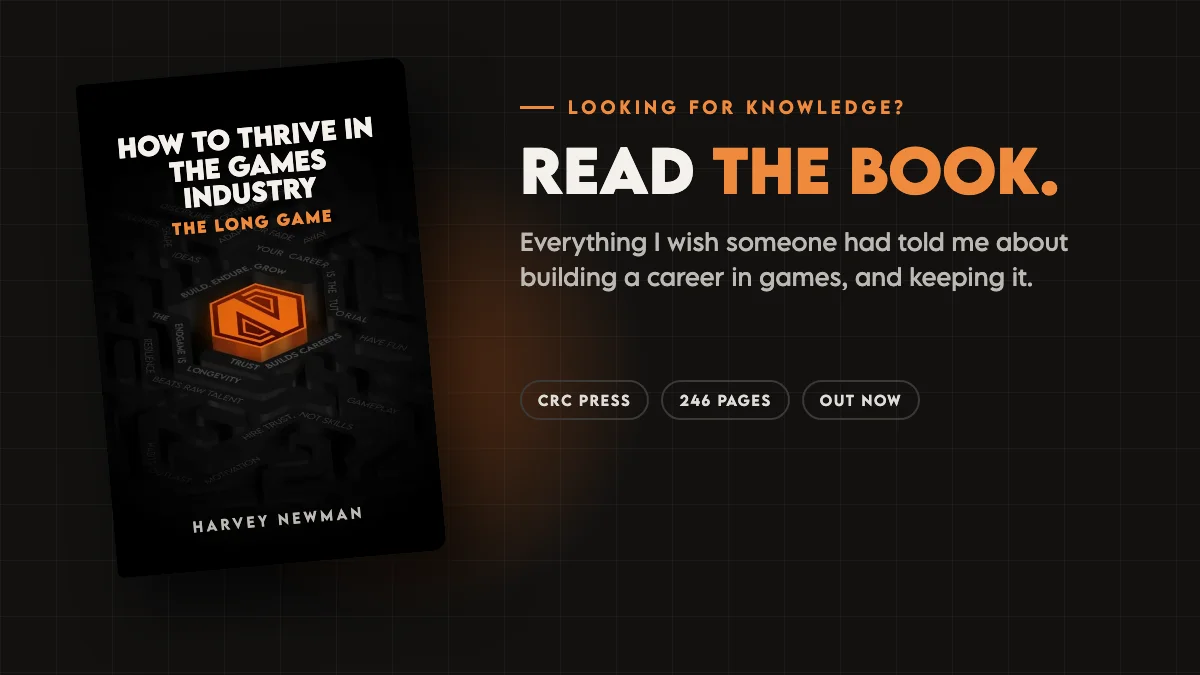 Looking for knowledge?How to Thrive in the Games Industry: The Long GameMy book on building a career in games and keeping it. CRC Press, 246 pages.Get the book →
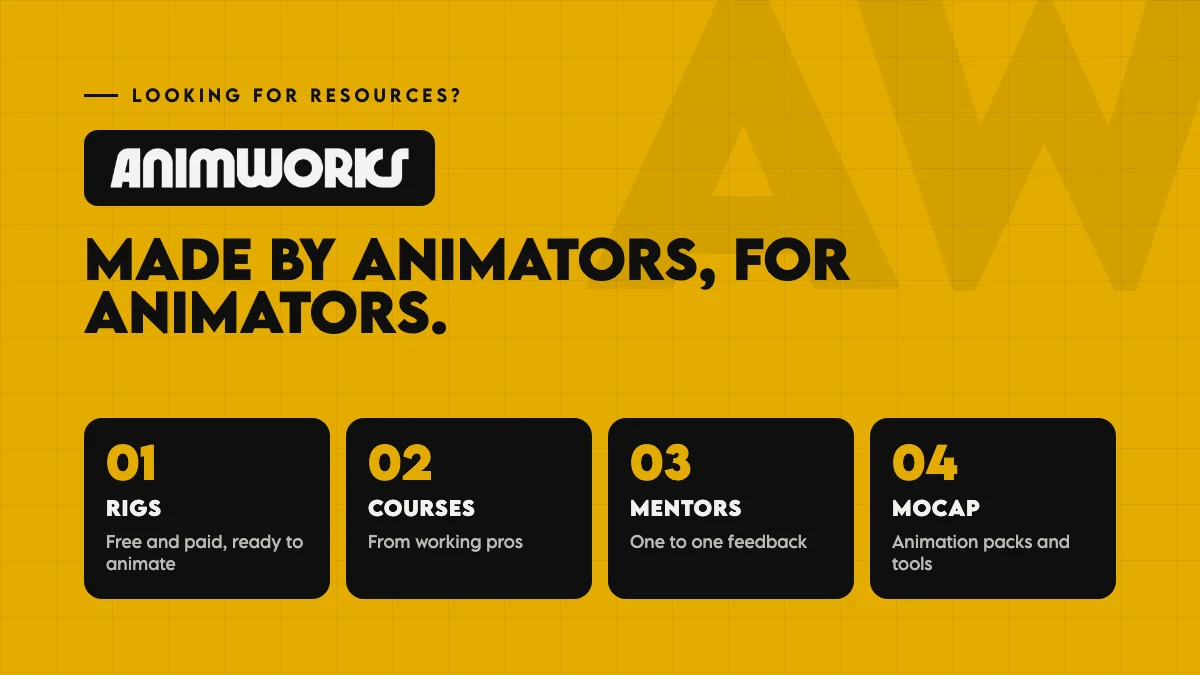 Looking for resources?Rigs, courses and mentors on AnimworksFree and paid rigs, courses from working pros, one to one mentoring and mocap packs.Visit anim.works →
 5 Game Development Career Myths That Cost Me 20 Years29 May 2026
 Can't Find Animation Jobs? Advice for Animators Struggling Right Now23 Jan 2026
 The Game Animation Pipeline: How I Build One, AAA or Indie12 Jun 2026
 The Junior Game Developer Time Bomb, and the Back Doors Still Open17 Jul 2026