
Animation craft7 min read14 min video
The room goes quiet. The notes start. It's not about you.
What an Animation Director Really Looks For in Dailies
Key takeaways
- In dailies, an animation director is judging whether your work fits the project and how far it is from the end goal, while juggling systems, design and the next meeting.
- The notes are about the work, not about you. The sooner you stop taking them personally, the faster you improve.
- Most notes fall into four buckets: intent, body mechanics, performance and in-game integration.
- In games, integration is arguably the most important: an animation has to feel as good on the controller as it looks in the playblast.
- If you don't understand a note, ask. And if you're the director, write your notes down so the whole team can use them.
There’s a moment in every animator’s career, whether you start in a games studio, a film studio or VFX, when you sit through your first dailies. Nothing is more terrifying.
I’m Harvey Newman, and I’ve spent over 20 years in games, mostly as an animation director and lead on AAA titles. Most recently that was Dune Awakening, and before that GoldenEye, Dead Space, Crysis, Star Wars Battlefront and Battlefield. This post demystifies what an animation director is looking for in dailies, the notes you should expect, and the lingo that sounds like a foreign language when you’re starting out.
Don’t make it personal, because it’s never personal.
What are dailies in animation?
The more experience you have, the more you realise how much dailies, or animation reviews, matter. Every studio does them slightly differently:
- Some studios hold weekly reviews, some daily.
- In games, a review is sometimes impromptu.
- Hand-keyed projects need more massaging, more reviews and more hands-on time.
- Motion capture projects usually need less. If the director was there for the capture, you know roughly what you’re going to get, and your job is to clean up the data as well as you can.
In the review itself, a group of animators gets together with the director or lead, and you show the work you’ve done since the last one. You might be in one group or several. The director dissects it and tells you what’s working and what isn’t.
If you’ve seen behind the scenes footage from Pixar, with the director in the screening room saying “more of this, less of that”, that’s the idea. There’s good feedback and bad feedback. I’ve had both.
What goes on in an animation director’s head?
You walk into a room full of animators. Everybody’s looking at you. Most people are nervous. On a big team you do it in groups, and the director can feel like someone who’s always too busy.
From the animator’s side, you’re crossing your fingers. I hope they like my stuff. You listen to every word, and what comes out is criticism, criticism, criticism. That was disheartening for me. I kept hoping for “great job, keep going”, and it rarely came.
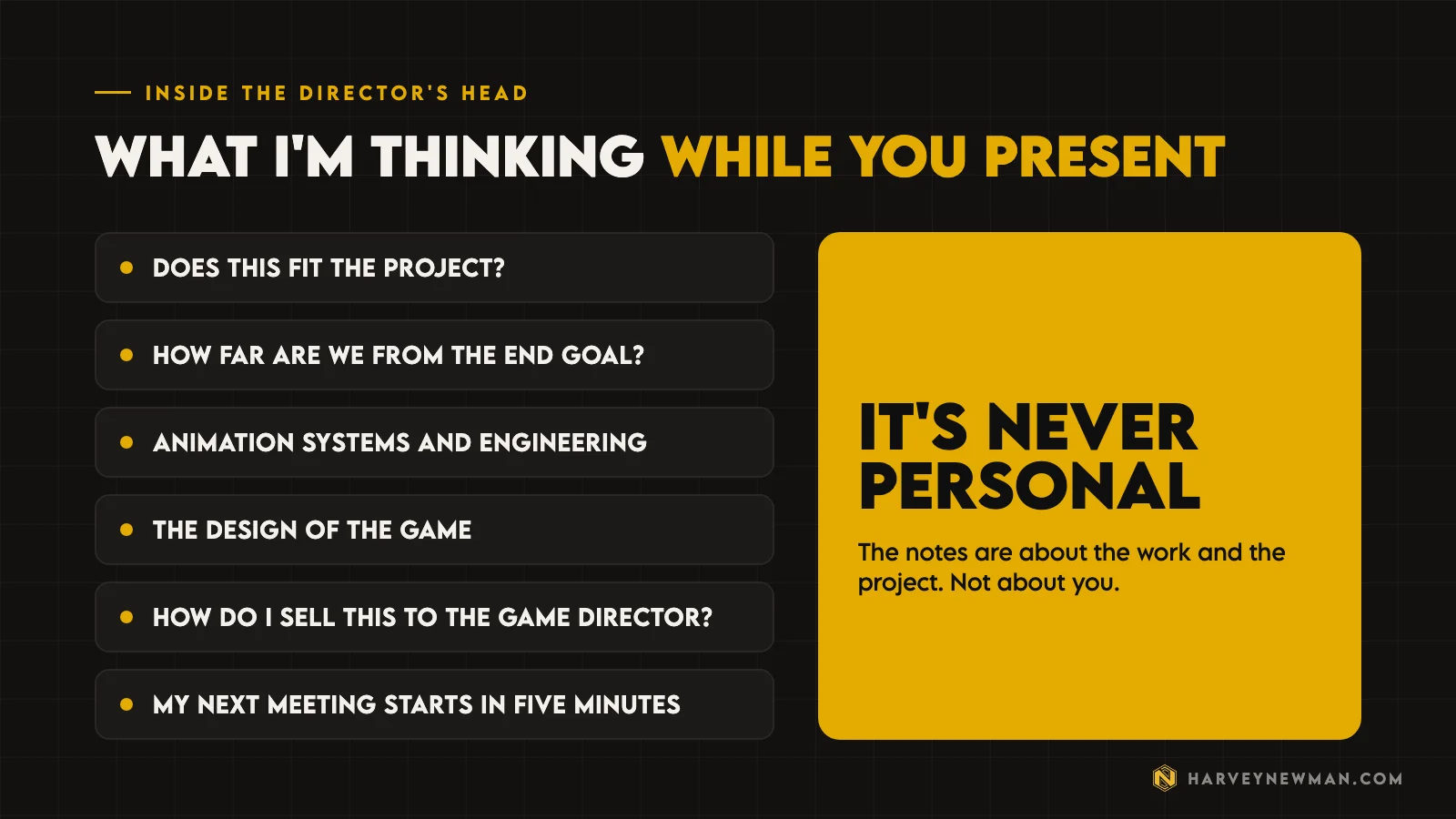
There’s a reason. As you become more experienced as a director, you almost grow calluses towards creativity. You’ve seen so much of it and done so much of it that you’re thinking about the project. You look at an animation and ask:
- Does it fit?Does this animation fit the project, and how well?
- How far to go?How much is left before we reach the end goal? That's what a director is chasing.
- What else does it touch?Animation systems, engineering, the design of the game, and how to sell it to the game director.
- What's next?There's another meeting straight after this one. Get through it and move on.
Why animation feedback is never personal
That’s what’s going on in the director’s head when they give you notes. They care about getting the work done and getting the project across the line.
The less personal you make it, the better animator you'll become.
Harvey Newman
It took me years to learn this. Once I stopped making it personal, every review became about the work. Maybe I’d done something that wasn’t needed, or the quality wasn’t as high as it should have been. That’s about me and my craft getting better, not about me as a person.
What notes does an animation director give?
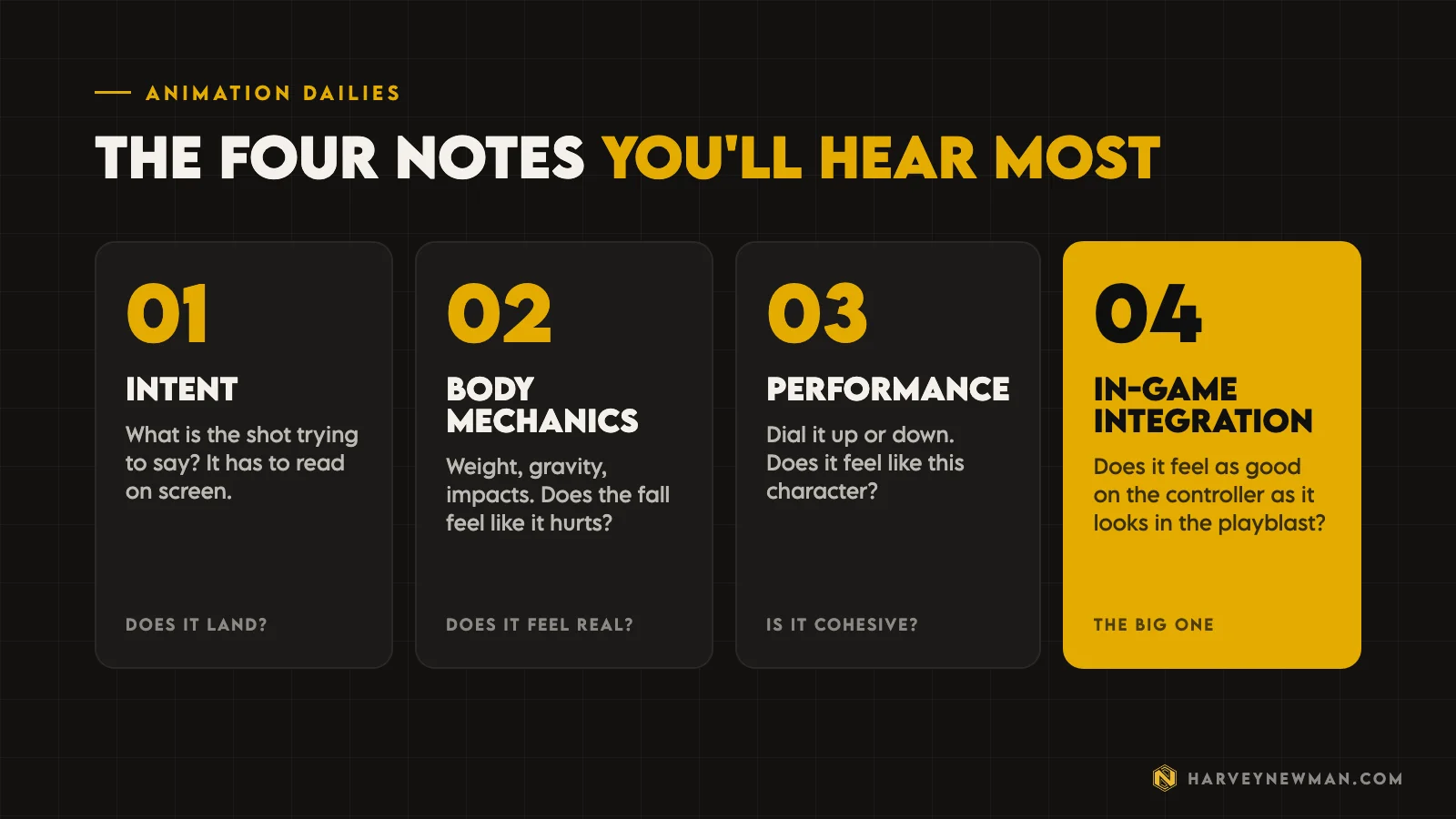
Now you know what’s in the director’s mind, here are the four kinds of notes to expect.
1. Intent
What is this shot trying to say, do or achieve? Whatever the intent is, it needs to be seen in the shot. When a note is about intent, I drill into it and talk with the animator about what the intention is supposed to be and how we tweak what we have. Sometimes we put it aside and try again. Sometimes it’s a tweak here and there.
2. Body mechanics
Games are huge on body mechanics. Think of any game you’ve played: it’s mostly about what the character is doing. Jumping, climbing, whatever it is. Does he have enough weight? Does he hit a wall in a way that feels like it’s going to hurt? Does he hit the floor with enough weight? Does it feel like there’s gravity?
3. Performance
Does anything need dialling up, or toning down? Say the character hits a wall, hurts himself and keeps walking forward. Does that feel good enough?
Characters also need to feel distinct, especially main characters versus secondary ones. Each one has a through line you follow for the whole game, so the character always feels like the same person. That comes through in the acting: the way they walk, run or limp in gameplay, or their performance in cinematics. Either way, I’m checking that everything is cohesive.
4. In-game integration
Arguably the most important of them all. You may know about the three Cs and game feel, and how much of that comes down to animation.
Your animation can look beautiful in a playblast or a render, on a 2D plane. Until I see it in game and play it with a controller or keyboard and mouse, I don’t know for sure it will feel as good as it looks. That’s part of why directors can seem a little blasé about animations that look great on screen.
When I press a button, is this going to feel as good as it looks? We don’t know until it’s in game.
My job is to tell you the pitfalls. So I’ll say something like: “This looks fantastic. Let’s mark it done and implement it, but I think these things might be missing, or this might not hit, for these reasons.” If we can’t know for sure, it goes through implementation, and I’ll tell the animator it’s most likely coming back. Then we tweak the animation based on what the implementation is doing.
With experience, I can often spot what won’t work before implementation and ask for the fix in the animation first. That’s the balance. If you want to see where this sits in the bigger picture, I broke down the whole game animation pipeline in another post.
Animation director lingo, decoded
This is a big one. Directors get used to saying certain things. Some are personal habits, some are industry terms, and to a junior it can sound like we’re talking about air. That’s on us.
Whatever director or lead you have, the best thing you can do as a junior or mid-level animator is ask questions when you don’t know what they mean. Raise your hand and say, “Can you tell me what you mean by that?”
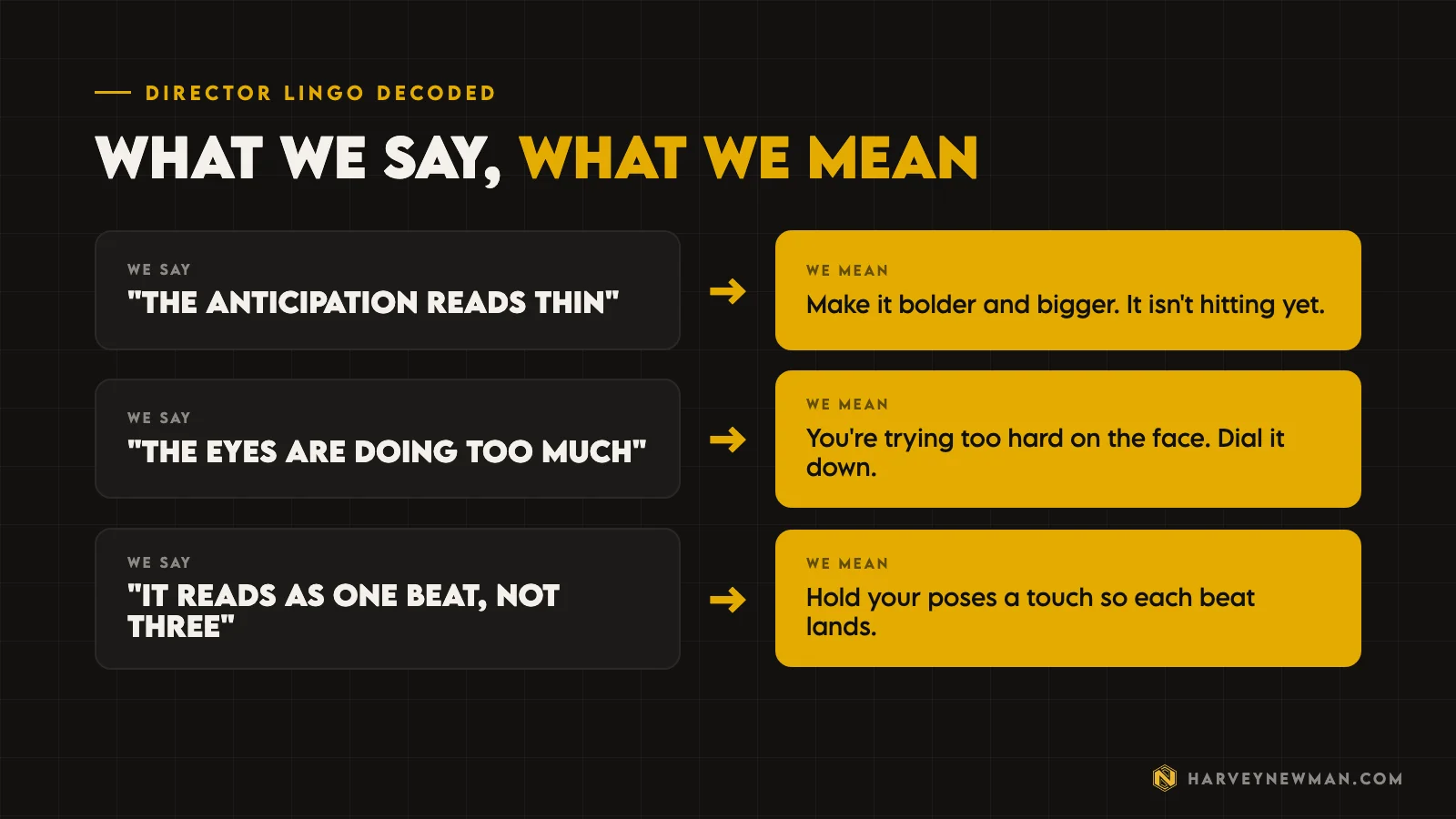
“The anticipation reads thin.” I’ve used this one. It means the anticipation needs to be bolder and bigger. It isn’t hitting yet.
“The eyes are doing too much.” This comes up a lot early in your career. You’re trying a little too hard on the face. Dial it down.
“This is reading as one beat instead of three.” I say this all the time, and it trips people up, especially juniors and mids. Think of beats like singing a song in your animation. An anticipation, then a bigger anticipation, then the punch: that’s three beats. Rush through them and it reads as one beat, or two. What the director wants is for you to hold your poses ever so slightly, so it feels like you’re winding up before you punch somebody.
Every project and every director has their own way of talking. These are just some of mine.
How should a director capture animation feedback?
This part is for the leads and directors reading.
In my experience the feedback itself is usually fine, especially from an experienced director. What’s missing in many studios is capturing that feedback, bottling it up so it can travel.
You give an animator a note today. It lands, everything’s fine, and it isn’t written anywhere. Two weeks later another animator makes a similar animation, and you give the same note again.
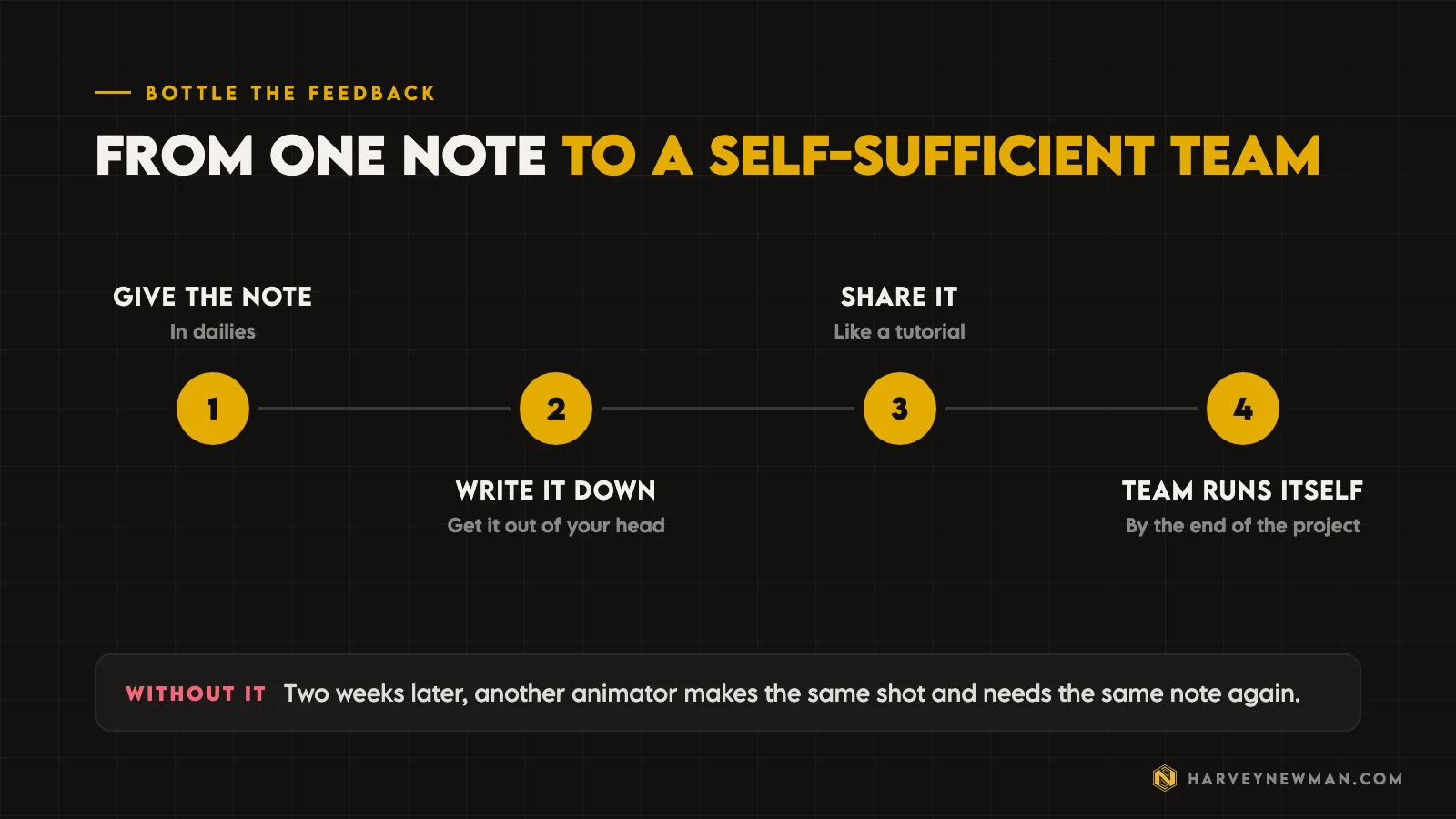
Getting that knowledge out of your head and into a place people can share is far more powerful. It works like a tutorial: if I know how to do something and I record it for the team, everyone can check it. The more independent the team is, the more I can get on with the director part of the job, which is meetings and decisions.
The best teams I've had were self-sufficient by the end of the project.
Harvey Newman
They knew exactly what a walk cycle for this character needed. We’d done a bunch already, so they did more of the same. That’s what you want as a director.
If you run an animation team and want help setting up reviews and feedback that scale, that’s the kind of thing I do through my consultancy.
Final advice for your first dailies
If you’re a junior or mid-level animator just getting started, remember three things. The director is thinking about the project, not about you. Most notes are about intent, mechanics, performance or integration. And when you don’t understand a note, ask. For more on what the job is like day to day, read the reality of being an animator.
Best of luck on your journey. If you have questions about anything here, or a note you’ve never been able to decode, leave it in the comments on the video.
The video
Watch the full breakdown
- 0:00First dailies terror
- 0:41My animation background
- 1:13Why dailies matter
- 1:57Inside a review room
- 2:38The director mindset
- 4:32Why it's never personal
- 5:22Note type one: intent
- 6:02Note type two: mechanics
- 6:30Note type three: performance
- 7:19Note type four: integration
- 9:09Director lingo decoded
- 11:18Bottling up feedback
- 13:09Final advice
Questions people ask
What are dailies in animation?
Dailies are regular reviews where animators show their latest work to a director or lead, who gives notes on what's working and what isn't. Some studios hold them daily, some weekly, and in games they can be impromptu.
What does an animation director look for in dailies?
Whether the work fits the project and how close it is to the end goal. The notes usually cover four things: the intent of the shot, body mechanics, performance, and how it will work once it's integrated in game.
Why does animation feedback feel so harsh?
Directors have seen a lot of work and are thinking about the whole project, the game systems, design and their next meeting. Feedback comes out as a list of fixes. It's about the work, not about you.
What does 'the anticipation reads thin' mean?
It means the anticipation isn't big or bold enough to register. Push it further so it hits before the main action.
What should a junior animator do if they don't understand a note?
Ask. Every director has their own lingo, and not explaining it is on us. Raise your hand and ask what they mean.
And remember,
there are no shortcuts for animation.
 Stay well, stay safe,Harvey NewmanBook a free call →
 Looking for knowledge?How to Thrive in the Games Industry: The Long GameMy book on building a career in games and keeping it. CRC Press, 246 pages.Get the book →
 Looking for resources?Rigs, courses and mentors on AnimworksFree and paid rigs, courses from working pros, one to one mentoring and mocap packs.Visit anim.works →
 The Reality of Being an Animator in 2026: How an Animation Career Has Changed16 Oct 2026
 Gameplay Animation Tips from a 5-Day Game Animation Streamathon16 Jan 2026
 The Junior Game Developer Time Bomb, and the Back Doors Still Open17 Jul 2026
 What Is Animation Consultancy? What an Animation Consultant Does for Your Studio9 Oct 2024