
AI and animation9 min read16 min video
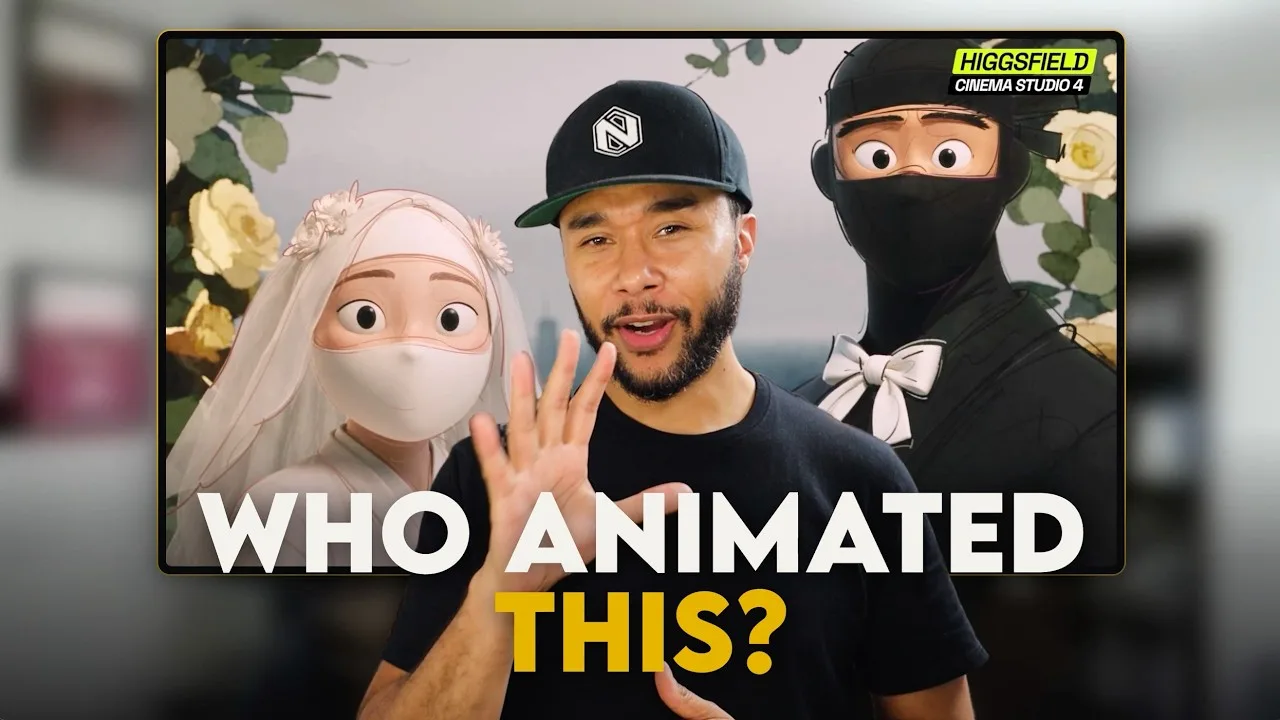
15,000 generations. $30,000. 5 minutes of animation.
AI Animation vs Traditional Animation: What Are We Losing?
Key takeaways
- Higgsfield Animation's short Passport Rush took 15,000 generations, about $30,000 in credits, nine people and three to four weeks for five minutes of animation.
- AI animation runs on a prompt loop: the AI gives you options, you pick one, you prompt again and hope it sticks.
- The 12 principles of animation are tools you choose between. AI tends to apply them evenly, which is why the result looks flat on a second watch.
- AI fills in the in-betweens the way software does, without a feel for which pose to favour.
- Use AI when you are stuck for ideas. Keep the top level creative decisions human.
5 minutes of animation, 15,000 generations, and about $30,000 in credits. That is what it took Higgsfield Animation to make one AI animated short, and they published every number, which I respect.
But more than the prompting and the cost, one question keeps coming back to me.
Are we losing the creative side of animation?
I’ve been an animator, animation lead and animation director for over 20 years, mostly in games and a little in film. This is how AI animation actually gets made, and where I think it falls short of traditional animation.

Credit where it’s due: Higgsfield and Passport Rush
I have to give props to the Higgsfield Animation team first. They are trying to make the most of animation in an AI world, and they publish exactly how they do it.
- Nine people worked on the short, called Passport Rush.
- It took three to four weeks.
- They show their failed attempts, which is great.
- It’s an open project, so anybody can look at the prompts and assets and see exactly how they built it.
- They have a real animation team. Their animators built their own sequence, and they bring animators in specifically because animators have the skills AI lacks.
This is in no way a slight on that team. It’s about the process it takes to make these shorts with AI.
I’m also all for shortcuts. Animation takes a long time to make, and if anything makes the process faster, I want it too. I’m just saying: watch what is happening in this AI animation field.
How AI animation gets made: the prompt loop
From what I’ve seen, and from using AI myself day to day, here’s how it works.
- OptionsThe AI shows you a handful of finished-looking options.
- SelectYou pick the one that feels closest to what you had in mind.
- Prompt againYou write a new prompt based on what it gave you, not on what you imagined.
- Bigger promptsThe prompts keep growing as you need more detail, and the loop starts again.
You also need different models, because different models are good at different things. Passport Rush used at least five tools. Claude wrote the prompts. Soul, Seedream and Nano Banana made the images, and Seedance 2.0 turned them into video. I counted at least 18 prompts, and Claude wrote all of them.

So what we’re doing is chasing results through prompting. The AI gives you options, you pick one, and you hope it sticks.
Who chose the style, you or the AI?
Higgsfield has another video on making eight different animation styles in one short film. One tip in it tells you a lot. Turn on the enhancer in Soul Cinema, type something as simple as “cartoon style man waking up in the bedroom”, and let it go wild. You’ll get styles you might never have thought to ask for.
Who chose the style? Was it him, or was it the AI?
Harvey Newman
Later in that video, he says he never described a girl called Anna. She just appeared, and he treated that as a positive.
I don’t know how I feel about that. Part of me says it’s a good thing, because when ideas bounce around, they pull in more ideas. But it’s also been handed to you, and it drifts away from the style you wanted. Is that a positive or a negative? I’ll leave that one with you.
Can AI animation ever be original?
AI sources data from lots of places, puts it together and gives you something else. For productivity that’s a real win. The more you use it, the better it understands you and the better your results get.
Art is different. In art you’re trying to make something that hasn’t been seen before. However detailed the prompt, I feel like nothing AI makes is truly unique. There’s an element of humanity in thinking of things that haven’t been thought of, and that’s what reads as originality. I don’t think AI is there, and I don’t know if it ever will be.
You don’t have to take my word for it. In their own breakdown, the team put two models together and said it was looking a little too much like AI, so they needed to make it look less like AI. Breaking away from that look is hard, and I think that’s why the prompts get so big.
AI animation and the 12 principles of animation
This is where it gets interesting for me.
The 12 principles of animation were written down a long time ago, when we needed rules to get consistent results. But they were never meant to be copy and paste. Timing, spacing, squash and stretch: these are tools. Animators pick and choose between them to make the best animation possible.
Any animation you see on Instagram or YouTube can look great at first glance. Passport Rush looks great on the surface, and again, kudos to the team.
But people like me analyse animation for a living. On a second watch you start asking what makes it tick: the timing, the spacing, the personality. Go deep on Passport Rush and it feels linear and flat. There’s no soul to it.
It’s the same difference I see between a junior or mid-level animator’s showreel and a senior or lead animator’s:
- The senior reel uses all of those tools to their best effect. It’s so appealing that you want to find out why.
- The weaker reel has an evenness to it. It’s flat and linear, and it leaves you slightly disappointed without you being able to put your finger on why.

That evenness is exactly what I see in AI animation.
Is AI the new inbetweener?
Another thing people do now is go to Blender first. They block out an animation with a cube or a simple character, so the AI can follow the motion to a tee and then make it pretty.

My question is: if you’re already animating in Blender, you’re already halfway there. What happens to the other half?
There used to be a job called the inbetweener. The main animators did the key poses, and the inbetweeners filled in the frames between them. You might see AI as your inbetweener.
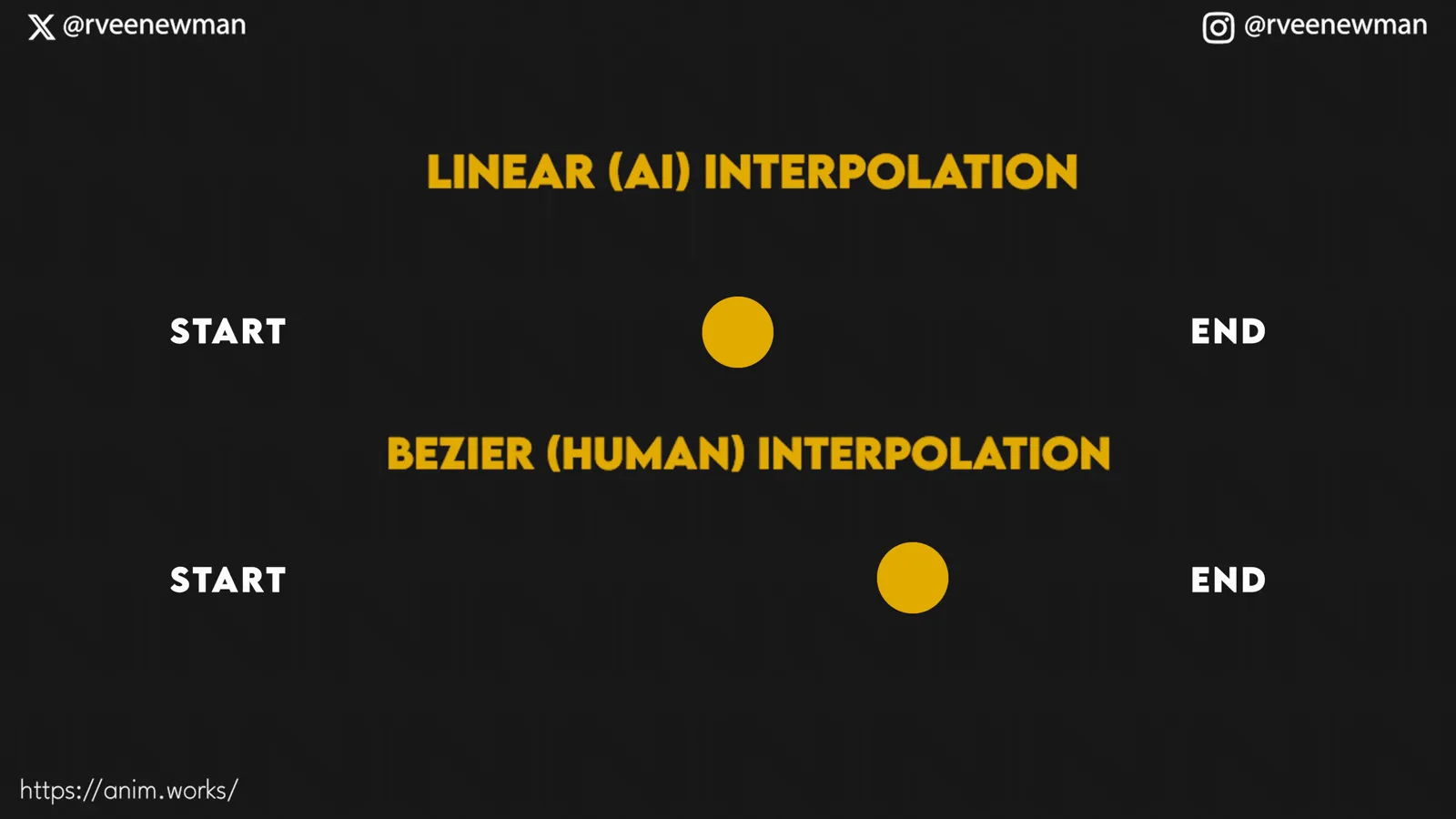
I made a video a while back calling Maya the worst inbetweener in the world. Give it a key on frame 1 and a key on frame 16, and the software fills the gap with an even, mechanical interpolation. It doesn’t know which pose to favour.
AI does exactly the same thing. We have a feel for how people move. The software doesn’t.
It’s very hard for AI to give you good in-betweens, meaning spacing that feels right and favours one side or the other the way a human would.
Where AI animation style breaks down
You see this all over Instagram and TikTok now: lots of animations that all look similar, though you can’t say exactly why.
Passport Rush is the most polished AI short I’ve seen, and the gaps are still there:
- The backgrounds are in slightly different styles.
- Some of the animation, like logs falling or passengers walking through the airport, is on twos.
- The main characters feel like they’re on ones, so they aren’t stylised at all.
Even if you’re not an animator, you can probably tell something isn’t quite there.
Compare that with Spider-Man: Into the Spider-Verse, the biggest example of a stylised film where every little detail was considered. Some eagle-eyed people will point out that it used AI. It did, but for repetitive technical work. It was never about the animation, the look or the creativity of the film. That’s where AI works well.
Why creative teams still matter
Put a group of creative people under one roof, all working towards one goal, and you get something fantastic. I don’t think AI gets that yet.

Think about how a shot moves down the pipeline. Concept art for the main characters. 3D statues for the animators to study. Models, animation, then visual effects, sound and rendering. At every step, someone is asking how to make it the best and most original it can be. That’s where the creativity of a shot comes from.
People are checking each other at every step too. A senior animator, a lead or an animation director will say, “This doesn’t animate correctly. This needs more of this.” The same is true in every department.
Brad Bird and the people learning 2D animation back then tell stories about the Nine Old Men. These masters of animation would grab a drawing, call it rubbish and tell you to do it again, properly. That’s how you become a better artist.
There's no shortcut to animation. You just have to do it.
Harvey Newman
You do it again and again, for many years, until you can feel the difference between good animation and bad.
The flipped pipeline
This is the part that confuses me most.
A traditional animation pipeline starts with concept. You imagine what it could be. Script and concept inspire each other. Then come the models and everything after, and finally you see one small finished scene.
AI flips that around. It makes everything look so good that every prompt gives you five finished-looking options. You pick the one that feels most personal, then prompt again for five more options for the next thing.

You’re looking at the final result every single time. Whether it’s a concept image or an animation, you start from something finished and tweak backwards into the middle. That costs a lot of credits. And you’re choosing from options instead of starting from a blank canvas.
I think that’s the biggest limit with AI right now.
Creating with AI, or AI creating for you?
People creating with AI right now feel like the work is theirs, and they feel like they made it.
But the AI assembled a bunch of different things into the look you liked, you selected it, and you’re running with it. So the inception of that shot is already not fully yours. The more you prompt, the further it drifts from human and towards something flat and inauthentic.
That lack of authenticity is what’s missing most from anything creative made with AI. I don’t think AI knows, at least for now, how to make something truly unique.
What $30,000 buys a real animation team
Long story short: 15,000 generations for 5 minutes of animation, by a team trying to do it properly, at a cost of $30,000.
If you run a small team of animators, you know $30,000 is real money to put into a short and do it the proper, creative way.
Use AI if you’re stuck for ideas. But for the top level creative decisions, we need to be the CEO.
We say what we want, and the AI can help a little if we need it. The brunt of the work needs to be done by people.
If there’s anything I’ve learnt in more than 20 years of animation, it’s that there are no shortcuts. If you want animation that connects with people and makes them feel something, it needs to be done properly.
I’d love to hear where you stand. Do you think animation should be done the way I’ve described, or is animating with prompts where we’re going? Come and tell me in the comments on the video.
The video
Watch the full breakdown
- 0:0015,000 generations, $30,000
- 0:28Credit to Higgsfield Animation
- 2:03The AI prompt loop
- 3:02Who chose the style?
- 4:09Nothing original with AI
- 5:45AI and the 12 principles
- 8:05Blender as AI previs
- 8:54AI is a linear in-betweener
- 9:59AI animation style gaps
- 11:17Creative teams under one roof
- 12:56The flipped animation pipeline
- 14:22Creating with AI, or AI creating?
- 15:26$30,000 on a real short
Questions people ask
Is AI animation good?
On the surface it can look great. Watch it a second time and analyse the timing, spacing and personality, and most AI animation feels linear and flat. It is the same gap you see between a junior showreel and a senior one.
How much does AI animation cost?
Higgsfield Animation published their numbers for Passport Rush: about 15,000 generations and $30,000 in credits for five minutes of animation, made by nine people over three to four weeks.
Can AI follow the 12 principles of animation?
It can produce timing, spacing and squash and stretch, but the principles were never meant to be applied evenly. Animators choose which ones to push and when. That choice is what AI is still missing.
Will AI replace animators?
Not for the work that connects with people. Even the teams making AI shorts bring in animators for the skills AI lacks. Use it to get unstuck, and keep the creative decisions with people.
What is an inbetweener in animation?
In traditional 2D animation, the lead animators drew the key poses and inbetweeners drew the frames between them. Some people now treat AI as their inbetweener, but it fills the gaps without a feel for spacing.
And remember,
there are no shortcuts for animation.
 Stay well, stay safe,Harvey NewmanBook a free call →
 Looking for knowledge?How to Thrive in the Games Industry: The Long GameMy book on building a career in games and keeping it. CRC Press, 246 pages.Get the book →
 Looking for resources?Rigs, courses and mentors on AnimworksFree and paid rigs, courses from working pros, one to one mentoring and mocap packs.Visit anim.works →
 The Evolution of AI in Animation: Where Art Meets Technology31 Jan 2025
 The Art of Animation: Bringing Stories to Life30 Oct 2024
 Game Animation Metrics: How They Shape Player Experience29 Nov 2024
 What Is Animation Consultancy? What an Animation Consultant Does for Your Studio9 Oct 2024